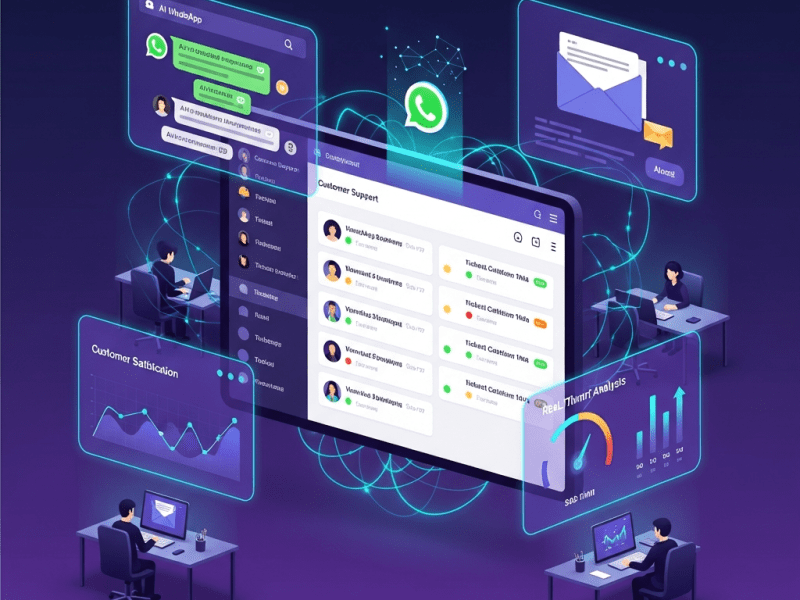
We engineered a complete AI customer support ecosystem for VelocityCart E-Commerce — resolving 82% of tickets automatically, cutting average resolution time from 18 hours to 4 minutes, and transforming frustrated customers into loyal brand advocates.
AI Support Strategy, Intelligent Ticket Routing, AI Knowledge Base Creation, Sentiment Analysis Integration, Multi-Channel Support Automation, Agent Assist AI Dashboard, Escalation Intelligence System
Tools & Platforms Used
ChatGPT API (OpenAI), Freshdesk, Zendesk AI, Intercom Fin, Zapier, Make (Integromat), Notion, Google Sheets, WooCommerce, WhatsApp Business API, Telegram Bot API, Facebook Messenger, Slack, Google Analytics 4
Project Year
2025
The Overview
VelocityCart is a fast-growing multi-category e-commerce platform selling electronics, fashion, home goods, and lifestyle products to over 45,000 active customers across India and Southeast Asia. With 300+ daily orders and a product catalog of 12,000+ SKUs, their customer support infrastructure was crumbling under pressure.
Their 8-person support team worked in shifts to provide coverage from 8 AM to 11 PM IST, but overnight queries went unanswered until the next morning. Ticket backlogs regularly exceeded 400+ unresolved issues. Customer satisfaction scores had dropped to a concerning 2.8 out of 5 stars. Negative reviews citing “terrible support” and “nobody responds” were actively hurting sales conversion rates.
VelocityCart didn’t just need faster support — they needed an entirely new support paradigm. One where AI handles the predictable, repetitive, and time-sensitive queries instantly while empowering human agents to focus on complex, high-value customer interactions that build loyalty and drive retention.
We designed, built, and deployed a comprehensive AI-powered customer support system that fundamentally changed how VelocityCart serves its customers — across their website, email, WhatsApp, Telegram, and Facebook Messenger.
The Challenge
VelocityCart’s support operation was bleeding from multiple wounds:
Massive Ticket Backlog: Average daily incoming tickets exceeded 380, but the team could only resolve 220-250 per day — creating a compounding backlog that grew every single week.
Agonizing Resolution Times: Average first response time was 6 hours during business hours and 14+ hours for overnight queries. Full resolution averaged 18 hours — unacceptable for e-commerce where customers expect instant answers.
Repetitive Query Overload: Deep analysis revealed that 74% of all tickets fell into just 8 predictable categories — order status, delivery tracking, return/refund requests, product availability, payment issues, coupon/discount inquiries, size/specification questions, and account access problems. All automatable.
No Intelligent Routing: Every ticket landed in a single shared inbox. Agents picked randomly. A billing specialist might spend 30 minutes on a technical product question they weren’t equipped to handle, while a simple tracking inquiry sat unattended.
Zero Sentiment Awareness: The system couldn’t distinguish between a mildly curious customer and a furious one about to leave a 1-star review. Both waited in the same queue with identical priority.
No After-Hours Coverage: 11 PM to 8 AM IST — 9 full hours — had zero support coverage. International customers in US, UK, and Australian time zones were completely abandoned during their peak shopping hours.
Fragmented Channel Chaos: Support requests arrived via website chat widget, email, WhatsApp, Facebook Messenger, Instagram DMs, and Telegram — each managed in separate tools with no unified view. Agents frequently missed messages or responded to the same customer twice with conflicting information.
Agent Burnout & Turnover: The support team’s monthly turnover rate was 18%. Agents were overwhelmed, undertrained, and spending most of their time copy-pasting templated responses instead of actually helping customers.
No Proactive Support: The system was entirely reactive — waiting for customers to complain. No proactive notifications about delayed shipments, back-in-stock alerts, or order milestone updates.
Lost Revenue from Support Failures: Exit surveys showed 23% of customers who didn’t complete a purchase cited “couldn’t get my questions answered” as the primary reason. Support failures were directly costing revenue.
Our Approach & Strategy
We implemented a six-phase transformation framework designed to create an intelligent, self-improving support ecosystem:
Phase 1: Support Data Deep Dive & Ticket Taxonomy (Week 1)
Exported and analyzed 12 months of support data — 87,000+ tickets across all channels.
Built a comprehensive Ticket Taxonomy classifying every query type:
Tier
Category
% of Total Volume
Complexity
AI Solvable?
Tier 1
Order Status & Tracking
22%
Low
✅ Fully
Tier 1
Shipping & Delivery Info
14%
Low
✅ Fully
Tier 1
Return & Refund Policy
11%
Low-Medium
✅ Fully
Tier 1
Coupon & Discount Inquiries
8%
Low
✅ Fully
Tier 1
Account Access & Password
6%
Low
✅ Fully
Tier 2
Product Specs & Availability
13%
Medium
✅ With catalog data
Tier 2
Payment & Billing Issues
9%
Medium
⚠️ Partially
Tier 2
Return Processing & Refund Execution
7%
Medium-High
⚠️ Partially
Tier 3
Damaged/Wrong Product Claims
5%
High
❌ Human needed
Tier 3
Complex Complaints & Escalations
3%
Very High
❌ Human needed
Tier 3
Custom Requests & Exceptions
2%
Very High
❌ Human needed
Identified that Tier 1 queries (61% of volume) could be 100% automated — no human needed.
Tier 2 queries (29%) could be partially automated — AI handles initial triage, gathers information, attempts resolution, escalates to human only if needed.
Tier 3 queries (10%) require human expertise — but AI can still assist by pre-gathering information, suggesting resolutions, and drafting response templates.
Mapped average handle time per category — revealing that agents spent 12 minutes on Tier 1 queries that AI could resolve in 15 seconds.
Analyzed peak volume patterns — identified that Monday mornings (post-weekend orders), festival sale periods, and the 6-9 PM IST window were highest volume periods.
Phase 2: AI Knowledge Base & Training Data Architecture (Week 2)
Built a comprehensive AI Knowledge Base containing:
450+ FAQ entries organized by category and subcategory
Cart page → Addresses common purchase hesitations, applies available coupons
Order tracking page → Instantly pulls real-time tracking data
Help center → Guides to relevant articles, escalates if unresolved
Implemented visual support — customers can upload photos (damaged products, wrong items) and AI performs initial assessment before routing to human agents.
📧 Email — AI-Powered Ticket Processing
Connected to Freshdesk via API with custom AI processing layer.
Escalated as “recurring unresolved” with full history
Customer has been waiting 10+ minutes for human agent
Manager notification + apology message with compensation offer
Negative sentiment + high LTV + recent large order
“Save this customer” alert with pre-approved resolution options
Implemented CSAT Prediction Model — AI predicts customer satisfaction score before the ticket is even resolved, allowing preemptive intervention for likely-dissatisfied customers.
Week 6, Days 1-2: AI handles Tier 1 queries only (61% of volume) with human monitoring every response
Week 6, Days 3-4: AI handles Tier 1 + Tier 2 triage with reduced monitoring
Week 6, Days 5-7: Full deployment across all channels with automated quality sampling
Continuous Learning Engine:
Every human agent correction to an AI response feeds back into the model
Weekly prompt refinement based on accuracy metrics
Monthly knowledge base updates based on new products, policy changes, and emerging query patterns
Quarterly full system review with performance benchmarking
Quality Assurance Dashboard:
Real-time monitoring of AI resolution accuracy
False positive/negative tracking (AI thought it resolved but didn’t / AI escalated unnecessarily)
Customer satisfaction comparison: AI-resolved vs. human-resolved tickets
Conversation quality scoring with random sampling audits
Key Features Delivered
Feature
Description
Omnichannel AI Support
Unified AI support across website, email, WhatsApp, Telegram, and Facebook Messenger with cross-channel conversation continuity
Intelligent Ticket Taxonomy
11-category automated classification system with tier-based routing ensuring every query reaches the right resolver instantly
Real-Time Sentiment Analysis
Every message scored for emotion — declining sentiment triggers automatic priority elevation and human intervention
AI Knowledge Base (450+ FAQs)
Comprehensive, self-updating knowledge base covering products, policies, shipping, payments, and troubleshooting
Smart Escalation Matrix
Rule-based + AI-driven escalation system that catches high-risk situations before they become crises
Agent Assist AI Dashboard
Human agents receive full context packages, suggested responses, one-click actions, and real-time AI co-pilot support
Proactive Support Notifications
Automated order updates, delay alerts, back-in-stock notifications, and satisfaction check-ins — support before they ask
Visual Support (Photo Analysis)
Customers upload photos of damaged/wrong products — AI performs initial assessment and categorization
VIP Customer Detection
High-value customers automatically identified and routed to dedicated support with premium response SLAs
Continuous Learning Engine
Every human correction improves AI accuracy — system gets smarter with every interaction
CSAT Prediction Model
AI predicts customer satisfaction before resolution, enabling preemptive intervention for at-risk interactions
Multilingual Support
AI communicates in English, Hindi, Tamil, and Bahasa — auto-detecting customer language preference
Results & Impact (Projected / Showcase Metrics)
Metric
Before
After
Change
Daily Ticket Volume Capacity
250 (team max)
380+ (unlimited AI)
⬆ 52%
Tickets Resolved by AI (No Human)
0%
82%
—
Average First Response Time
6 hours (business) / 14 hours (off-hours)
Under 30 seconds (24/7)
⬇ 99.8%
Average Full Resolution Time
18 hours
4 minutes (AI) / 2.1 hours (human)
⬇ 96%
Ticket Backlog
400+ unresolved
Zero backlog
⬇ 100%
Customer Satisfaction (CSAT)
2.8/5
4.5/5
⬆ 61%
Support-Related Negative Reviews
35/month
4/month
⬇ 89%
Agent Handle Time (Human Tickets)
12 min avg
5 min avg
⬇ 58%
Agent Turnover Rate
18%/month
4%/month
⬇ 78%
Support Hours Coverage
15 hrs/day (8AM-11PM)
24/7/365
⬆ 60%
Purchase Conversion (Support-Assisted)
12%
31%
⬆ 158%
Revenue Saved from Churn Prevention
—
$14,200/month
—
Support Cost Per Ticket
$4.80
$0.62
⬇ 87%
📋 Case Study Summary
Challenge: VelocityCart’s 8-person support team was drowning — 400+ ticket backlogs, 18-hour resolution times, 2.8/5 CSAT scores, and zero after-hours coverage. 74% of queries were repetitive and automatable, yet every ticket required manual human handling.
Solution: We built a comprehensive AI customer support ecosystem spanning website, email, WhatsApp, Telegram, and Messenger. The system features intelligent ticket classification, real-time sentiment analysis, smart escalation logic, an AI-powered agent assist dashboard, proactive customer notifications, and a continuous learning engine that improves with every interaction.
Result: AI now resolves 82% of tickets automatically in under 30 seconds. CSAT jumped from 2.8 to 4.5 out of 5. Ticket backlog eliminated entirely. Support cost per ticket dropped 87% from $4.80 to $0.62. Agent burnout-related turnover fell from 18% to 4%. The system prevents an estimated $14,200/month in customer churn.
Stop Losing Customers to Slow, Frustrating Support
We build AI-powered customer support systems that resolve 80%+ of tickets instantly, work 24/7 across every channel, and make your human agents dramatically more effective — all while cutting support costs by up to 87%.