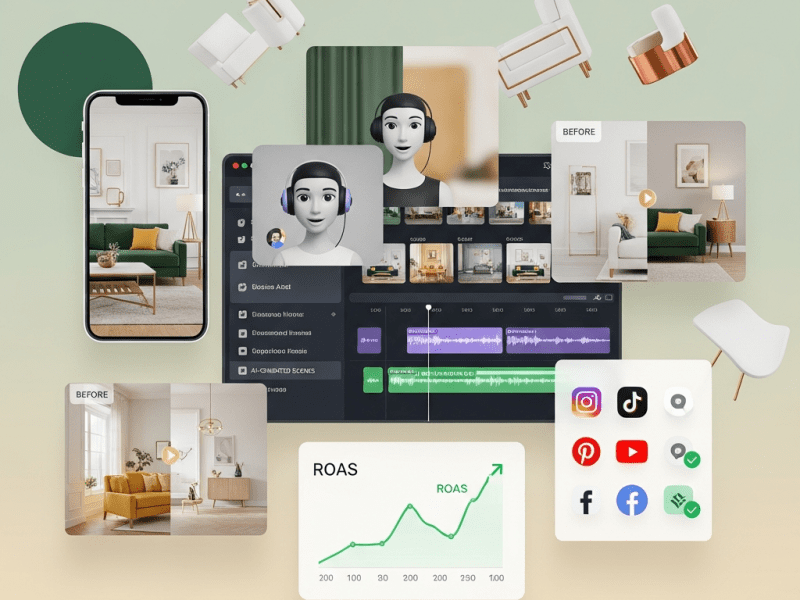
We built a complete AI video and ad creation studio for UrbanNest Home Décor — producing 280+ scroll-stopping video ads and static creatives monthly at 92% lower cost, increasing ROAS from 2.1× to 6.8× across five advertising platforms.
AI Video Production Strategy, AI Ad Creative Generation, Script-to-Video Automation, Dynamic Product Video Ads, UGC-Style AI Video Creation, Multi-Platform Ad Adaptation, Performance Creative Testing System, Brand Asset Library Development
Tools & Platforms Used
ChatGPT API (OpenAI), Runway ML, HeyGen, Synthesia, Eleven Labs, CapCut Pro, Canva AI, Predis.ai, AdCreative.ai, Midjourney, DALL·E 3, Pika Labs, D-ID, Descript, Meta Ads Manager, Google Ads, TikTok Ads Manager, YouTube Ads, Pinterest Ads, Zapier, Make (Integromat), Google Sheets, Airtable, Notion, WordPress, WooCommerce
Project Year
2025
The Overview
UrbanNest Home Décor is a direct-to-consumer e-commerce brand selling premium, design-forward furniture, home accessories, and décor pieces through their WooCommerce store and marketplace presence on Amazon and Flipkart. With a catalog of 450+ products, average order value of $185, and customers across India’s Tier 1 and Tier 2 cities, they’d built a loyal following — but growth had hit a visible ceiling.
The problem wasn’t their products. It wasn’t their pricing. It wasn’t even their marketing budget ($28,000/month across Meta, Google, YouTube, Pinterest, and TikTok). The problem was their creative production bottleneck.
In today’s scroll-first, video-dominant advertising landscape, the brands that win are the brands that produce the most creative variations, test relentlessly, and refresh their ads before fatigue sets in. UrbanNest was producing just 8-12 new ad creatives per month — a mix of static product images shot by their in-house photographer and occasional 30-second videos produced by a freelance videographer at $800-$1,200 per video.
By the time a video ad was conceptualized, scripted, shot, edited, and approved, 3-4 weeks had passed. By then, the trend had moved on, the ad fatigue had set in on their existing creatives, and competitors with faster creative cycles were eating their market share. They were stuck in an impossible loop: they needed more creative volume to scale profitably, but traditional production methods were too slow, too expensive, and too rigid to deliver.
We designed and deployed a complete AI-powered video and ad creation studio — a system that transforms product photos, brand guidelines, and strategic briefs into hundreds of platform-optimized video ads, static creatives, and UGC-style content pieces at a fraction of the traditional cost and timeline.
The Challenge
UrbanNest’s creative production operation was crippled by overlapping bottlenecks:
Catastrophic Creative Volume Deficit: Meta’s algorithm alone recommends testing 5-10 new creative variations per ad set per week for optimal performance. With 6 active campaigns across 4 product categories, UrbanNest needed 120-240 new creatives per month minimum. They were producing 8-12. Their creative pipeline was operating at roughly 5% of required capacity.
Agonizing Production Timelines: The average lifecycle of a single video ad from concept to published:
Day 1-3: Creative brief and concept development
Day 4-7: Script writing and revision (2-3 rounds)
Day 8-12: Videographer scheduling, shooting, and raw footage delivery
Day 13-17: Editing, motion graphics, music, and sound design
Day 18-20: Internal review and revision rounds (average 2.4 rounds)
Day 21-25: Final approval and platform adaptation
Total: 3-4 weeks per video ad — in an industry where trends change weekly
Prohibitive Production Costs: Each professionally produced video ad cost $800-$1,200. At the volume needed (120+ per month), traditional production would cost $96,000-$144,000 monthly — more than 3× their entire marketing budget. Even their static creatives cost $150-$300 each when including photographer and designer time.
Single-Format Limitation: Every ad was produced in one format and one aspect ratio. A 16:9 YouTube ad couldn’t be used on Instagram Stories (9:16) or Facebook Feed (1:1) without expensive re-editing. Platform-specific creative optimization was virtually nonexistent.
No UGC-Style Content: User-generated content style ads consistently outperform polished studio content on Meta and TikTok — often by 40-70% in engagement and conversion rates. But UrbanNest had no UGC creator network, no system for producing authentic-feeling content at scale, and their brand team was uncomfortable with “imperfect” aesthetics.
Creative Fatigue Destroying ROAS: The same 8-12 ads ran for 6-8 weeks before being replaced. By week 3, frequency metrics showed the same users were seeing the same ads 8-12 times. Click-through rates dropped by 65% after week 3. Cost per acquisition (CPA) increased by 120% on fatigued creatives. Their Return on Ad Spend (ROAS) had declined from 3.4× to 2.1× over the past 6 months — primarily due to creative fatigue.
Zero Product Launch Velocity: When UrbanNest launched a new product collection (every 6-8 weeks), it took 2-3 weeks to produce launch ads — meaning the critical launch momentum window was completely missed. Competitors who could produce launch-day creative won the discovery battle.
No Creative Performance Data Loop: The team had no system connecting ad creative performance back to creative production decisions. Nobody could answer: “Which visual style generates highest ROAS?” “Do lifestyle shots outperform product-on-white?” “Does the ‘problem-agitation-solution’ script framework beat ‘benefit-led’ frameworks?”
Platform Mismatch: The same generic 30-second horizontal video was uploaded to YouTube, Instagram Reels, TikTok, Facebook Feed, and Pinterest — ignoring that each platform has dramatically different creative best practices, optimal lengths, and audience expectations.
Seasonal & Trend Paralysis: When a home décor trend went viral on Instagram or TikTok (e.g., “cottagecore,” “japandi minimalism,” “dopamine décor”), UrbanNest couldn’t produce trend-aligned content fast enough to capitalize. By the time their videos were ready, the trend had peaked and declined.
Our Approach & Strategy
We built the AI creative studio in five structured phases:
Phase 1: Creative Audit, Brand System & AI Asset Preparation (Week 1)
Before generating a single AI creative, we needed to build the foundation:
Creative Performance Audit:
Analyzed 18 months of ad performance data across all platforms (142 total creatives):
Ranked every creative by ROAS, CTR, CPA, thumb-stop rate (3-second video view rate), and hold rate (% watched to completion)
Identified the Top 15 highest-performing creatives and reverse-engineered what made them work:
Pattern Identified
Performance Impact
Frequency in Top 15
Product shown in real room setting (lifestyle)
+43% CTR vs. product on white background
13 of 15
Human hand interacting with product in first 2 seconds
+67% thumb-stop rate
11 of 15
Text overlay with benefit statement in first 1.5 seconds
+38% hold rate
12 of 15
Before/after room transformation
+52% conversion rate
8 of 15
Warm, natural lighting (vs. studio lighting)
+28% engagement rate
14 of 15
UGC-style handheld camera feel
+71% CTR on Meta, +89% on TikTok
6 of 15 (all top performers on Meta/TikTok)
Music with trending audio
+44% completion rate on Reels/TikTok
7 of 15
Price/offer revealed at end (not beginning)
+33% watch-through rate
10 of 15
Identified the Bottom 15 worst-performing creatives and cataloged failure patterns:
Overly polished, commercial-style videos (felt like TV ads — users scrolled past)
Product features listed without emotional context
No human element (just product floating in space)
Slow intros (no hook in first 1.5 seconds)
No text overlays (users watch with sound off — 85% of Meta, 65% of TikTok)
Generic stock music
Single aspect ratio used across all platforms
Brand Creative System (AI-Ready):
Built a comprehensive Brand Creative Toolkit specifically designed for AI generation:
Photography Style: Lifestyle-first, real rooms over studio, warm tones, morning/golden hour lighting, human elements (hands, silhouettes, daily-life moments)
Tone of Voice for Ad Copy: Warm, aspirational but accessible, “design for real life” positioning, conversational not corporate, subtle wit
Music & Audio Direction: Acoustic, warm, lo-fi beats, trending sounds for short-form, brand audio signature for YouTube
15 “Do” Examples + 15 “Don’t” Examples — visual reference library for AI training
Product Asset Library Preparation:
Organized all 450+ product SKUs with:
High-resolution product photos (minimum 3 angles per product)
Output: 3 script variations × 3 aspect ratios = 9 video ad variations per product in approximately 45 minutes
Track 2: UGC-Style AI Talking Head Videos
Input: Product + key selling points + target audience persona
Process:
ChatGPT generates authentic-sounding UGC scripts (“I just bought this shelf from UrbanNest and honestly? I’m obsessed…”)
HeyGen creates realistic AI-generated presenter videos using diverse avatar models
Product B-roll footage (AI-generated or from product library) intercut with talking head
Captions auto-generated and styled in trending format (bold yellow/white text, word-by-word animation)
Trending audio/music overlaid
Exported in 9:16 for Reels, TikTok, and Stories
Output: 4 presenter variations × 3 script angles = 12 UGC-style videos per product in approximately 60 minutes
Key Innovation: These look and feel like genuine user-generated reviews — but are produced entirely by AI, maintaining brand messaging accuracy while capturing the authentic, relatable energy that drives engagement
Track 3: Before/After Transformation Videos
Input: Room “before” scene (bare/bland) + Room “after” scene (styled with UrbanNest products)
Each voiceover generated in under 60 seconds per script — versus 2-3 day turnaround and $150-$300 cost per session with human voice talent
Phase 4: Multi-Platform Ad Deployment & Testing System (Week 4)
Creating ads is only valuable if they’re deployed strategically and tested systematically:
Platform-Specific Creative Optimization Matrix:
Platform
Optimal Length
Aspect Ratio
Hook Window
Audio
Text Overlay
CTA Style
Instagram Reels
15-30 sec
9:16
0.8 sec
Trending audio essential
Bold, centered, word-by-word animation
“Shop Now” button overlay
TikTok
15-45 sec
9:16
0.5 sec
Native/trending sounds
Casual, subtitle-style, yellow/white
“Link in bio” or TikTok Shop
Facebook Feed
15-60 sec
1:1 or 4:5
1.5 sec
Optional (85% watch muted)
Headline at top, benefit bullets
“Shop Now” or “Learn More”
YouTube Shorts
15-60 sec
9:16
1.0 sec
Music + voiceover
Minimal, clean
End card with CTA
YouTube In-Stream
15-30 sec (skippable)
16:9
5 sec (before skip button)
Full audio + voiceover
Minimal text, brand watermark
Companion banner + end CTA
Google Display
6-15 sec (bumper)
16:9 + 1:1
Instant
None (autoplay muted)
Product + price + offer
Click overlay
Pinterest Video Pins
15-30 sec
2:3 or 9:16
1.0 sec
Soft music
Elegant, minimal, serif font
“Get the look” or “Shop”
Every AI-generated video automatically exported in all required formats for each platform — a single creative concept becomes 7 platform-optimized versions without manual re-editing
Structured Creative Testing Protocol:
Implemented a systematic testing methodology replacing random ad uploads:
AI CREATIVE TESTING PROTOCOL ━━━━━━━━━━━━━━━━━━━━━━━━━━━━━━━━━━━━━━━━━━━
LEVEL 1: CONCEPT TEST (Week 1) → Test 5 different creative concepts per product → Budget: $20/concept ($100 total) → Duration: 3 days → Metric: Thumb-stop rate (3-sec view) + CTR → Winner: Top 2 concepts advance
LEVEL 2: VARIATION TEST (Week 2) → For each winning concept, test 4 variations: • Different hooks (first 2 seconds) • Different scripts (same visual, different copy) • Different CTAs • Different music/audio → Budget: $15/variation ($120 total) → Duration: 4 days → Metric: CTR + CPA → Winner: Top variation per concept advances
🎬 PRODUCTION METRICS Total Creatives Produced (This Month): [Live] Videos Produced: [Live] Static Ads Produced: [Live] Average Production Time/Creative: [Live] Production Cost/Creative: [Live] Creatives in Testing Queue: [Live]
📊 PERFORMANCE METRICS (Cross-Platform) Overall ROAS: [Live] Best Performing Creative: [Thumbnail + ROAS] Best Performing Framework: [Name + Avg ROAS] Best Performing Platform: [Name + ROAS] Best Performing Audience: [Name + ROAS] Creatives in "Fatigue Zone": [Count + Alert]
📈 CREATIVE INSIGHTS (AI-Generated Weekly) • "Before/After transformation videos outperforming product showcases by 2.3× ROAS this week" • "UGC-style content with 'Ananya' voice generating 41% higher CTR than 'Narrator' voice on Instagram" • "Cottagecore trending content producing 3.1× ROAS — recommend scaling budget 40%" • "Pinterest ROAS up 67% since switching to 2:3 aspect ratio — continue optimizing for this format"
🔄 CREATIVE LIFECYCLE Active Creatives: [Count] Average Creative Lifespan: [Days] Creatives Retired This Month: [Count] Refresh Pipeline (In Production): [Count] ━━━━━━━━━━━━━━━━━━━━━━━━━━━━━━━━━━━━━━━━
AI Creative Learning Loop:
Every creative’s performance data feeds back into the AI production system:
Which script frameworks generate highest ROAS? → Prioritize those frameworks for new creatives
Which visual styles get highest thumb-stop rates? → Weight AI image generation toward those styles
Which hooks generate longest watch time? → Train ChatGPT to prioritize those hook patterns
Which voiceover profiles perform best by platform? → Auto-assign optimal voice per platform
Which aspect ratios drive most conversions per platform? → Auto-prioritize winning ratios
The system literally gets smarter with every ad it produces — each creative teaches the AI what works better
Monthly Creative Strategy Report (AI-Generated):
Comprehensive analysis delivered first Monday of each month:
Top performing creative themes, formats, and frameworks
Underperforming categories with recommended pivots
Emerging trends to capitalize on
Competitor creative landscape changes
Recommended creative mix for next month
Budget allocation recommendations by platform and format
New product launch creative plan
Scaling Playbook:
Created automated scaling rules:
Trigger
Action
Creative achieves ROAS > 5× for 3+ consecutive days
Auto-increase budget 20% daily (capped at 3× original)
Creative achieves ROAS > 8× for 5+ consecutive days
Flag as “Evergreen Winner” — never pause, only refresh visually
Creative drops below ROAS 2× for 2+ consecutive days
Auto-reduce budget 50% + trigger fatigue check
Creative drops below ROAS 1× for 3+ consecutive days
Auto-pause + archive + trigger replacement production
New product added to WooCommerce
Auto-generate 15 creative variations within 24 hours
Sale/promotion activated
Auto-generate promotion overlay versions of top 10 performing creatives
Key Features Delivered
Feature
Description
5-Track AI Video Production System
Product showcases, UGC-style talking heads, before/after transformations, dynamic catalog videos, and trend response content — all AI-generated
Multi-Platform Auto-Adaptation
Every creative auto-exported in 7 platform-specific formats (Reels, TikTok, Feed, YouTube, Shorts, Display, Pinterest) — no manual re-editing
12 Script Framework Library
Battle-tested script templates for ChatGPT generating high-converting ad copy in seconds
4 AI Brand Voice Profiles
Custom Eleven Labs voiceover personalities matched to different content types and platforms
Structured Creative Testing Protocol
4-level systematic testing methodology (Concept → Variation → Audience → Scale) replacing random ad uploads
Creative Fatigue Auto-Detection
Real-time monitoring that detects performance decline and triggers AI creative refresh before ROAS drops
Dynamic Catalog Videos
Auto-updating video ads that refresh product data, pricing, and offers directly from WooCommerce — zero manual maintenance
Competitor Creative Intelligence
Weekly AI analysis of competitor ad libraries identifying trends, gaps, and competitive response opportunities
AI Creative Learning Loop
Performance data continuously feeds back into AI production — the system produces better-performing creatives with every iteration
Brand Creative Toolkit
Comprehensive AI-ready brand system including color palette, typography, visual style guide, photography direction, voice profiles, and “Do/Don’t” examples
50 AI Lifestyle Room Scenes
Photorealistic room settings generated via Midjourney for instant product placement — eliminating the need for physical photo shoots
Creative Intelligence Dashboard
Real-time dashboard tracking production volume, performance metrics, creative lifecycle, and AI-generated optimization insights
Results & Impact (Projected / Showcase Metrics)
Metric
Before
After
Change
Creative Output/Month
8-12 pieces
280+ pieces
⬆ 2,233%
Video Ads Produced/Month
2-3 videos
180+ videos
⬆ 5,900%
Average Production Time/Creative
3-4 weeks
45 minutes
⬇ 99.7%
Average Production Cost/Video
$800-$1,200
$12-$18 (AI + tools)
⬇ 98.5%
Monthly Creative Production Cost
$12,000+
$960
⬇ 92%
Overall ROAS (Return on Ad Spend)
2.1×
6.8×
⬆ 224%
Cost Per Acquisition (CPA)
$48
$16.20
⬇ 66%
Average Ad Creative Lifespan
6-8 weeks (with fatigue)
12-16 days (auto-refreshed)
Optimized
Thumb-Stop Rate (3-sec view)
22%
51%
⬆ 132%
Click-Through Rate (CTR)
0.8%
3.2%
⬆ 300%
Monthly Ad-Attributed Revenue
$58,800
$190,400
⬆ 224%
New Product Launch Creative Time
3-4 weeks
24 hours
⬇ 96%
Platform Coverage
2 platforms (Meta + Google)
5 platforms (+ TikTok, YouTube, Pinterest)
⬆ 150%
Trend Response Time
2-3 weeks (usually too late)
Under 4 hours
⬇ 99%
📋 Case Study Summary
Challenge: UrbanNest Home Décor was producing just 8-12 ad creatives per month at $800-$1,200 per video — a fraction of the 120+ needed for profitable scaling. Creative fatigue had eroded ROAS from 3.4× to 2.1×. Production took 3-4 weeks per video. They couldn’t respond to trends, launch products with speed, or test enough variations to find winning ads.
Solution: We built a complete AI video and ad creation studio — a 5-track production system generating product showcases, UGC-style talking heads, before/after transformations, dynamic catalog videos, and trend-response content using Runway ML, HeyGen, Eleven Labs, ChatGPT, Midjourney, and CapCut. Combined with structured testing protocols, creative fatigue auto-detection, multi-platform auto-adaptation, and a performance learning loop that continuously improves output quality.
Result: Creative output exploded from 12 to 280+ pieces monthly at 92% lower cost ($12-$18 per video vs. $800-$1,200). ROAS tripled from 2.1× to 6.8×. CPA dropped 66%. Monthly ad-attributed revenue jumped from $58,800 to $190,400. New product launch creatives now ship in 24 hours instead of 3-4 weeks. Trend response time collapsed from weeks to under 4 hours.
Stop Letting Creative Bottlenecks Strangle Your Ad Performance
We build AI-powered video and ad creation studios that produce hundreds of scroll-stopping, platform-optimized creatives at a fraction of traditional costs — turning your ad budget into a revenue multiplication machine with relentless creative testing and AI-driven optimization.
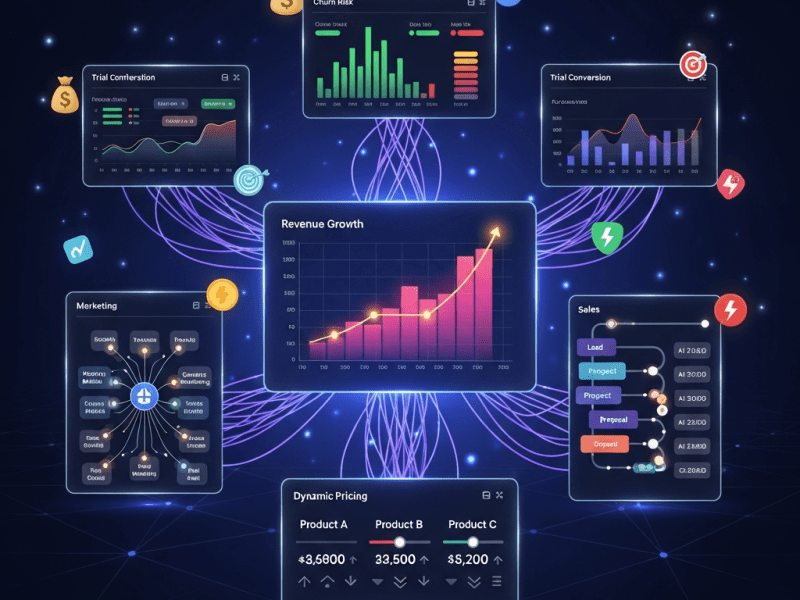
We engineered a comprehensive AI sales and marketing intelligence system for NovaBridge SaaS — unifying predictive analytics, AI-driven campaigns, dynamic pricing, and intelligent sales coaching to increase revenue 127% and cut customer acquisition cost by 54%.
AI Sales Intelligence Strategy, Predictive Sales Analytics, AI Marketing Automation, Dynamic Pricing Intelligence, Conversion Optimization AI, Sales Coaching AI System, Revenue Attribution Modeling, AI-Powered Retargeting
Tools & Platforms Used
ChatGPT API (OpenAI), HubSpot CRM & Marketing Hub, Gong.io, Drift, Clearbit, Mutiny, Seventh Sense, Zapier, Make (Integromat), Google Analytics 4, Google Ads, Meta Ads Manager, LinkedIn Ads, Hotjar, Mixpanel, Airtable, Slack, Loom, Stripe, ProfitWell, WordPress
Project Year
2025
The Overview
NovaBridge is a B2B SaaS platform offering workforce management and HR automation solutions to mid-market companies across India, Southeast Asia, and the Middle East. With three pricing tiers ($299/mo, $799/mo, $1,499/mo), 620 active paying customers, and a 14-day free trial model, they’d achieved $4.2M in annual recurring revenue (ARR) — impressive for a 3-year-old company, but far below their $10M ARR target.
Their growth was plateauing. Marketing campaigns generated traffic but couldn’t pinpoint which visitors were genuinely ready to buy versus casually browsing. The sales team closed deals based on gut instinct rather than data. Pricing was static despite vastly different customer segments. Trial-to-paid conversion sat at a frustrating 11%. Churn was quietly bleeding revenue at 6.8% monthly. And nobody could definitively answer the most critical business question: “Which of our marketing efforts are actually generating revenue, and which are burning cash?”
NovaBridge didn’t need more marketing tools or another sales training program. They needed artificial intelligence woven into the DNA of their entire revenue engine — from first ad impression to closed deal to long-term retention.
We designed and deployed a holistic AI-powered sales and marketing intelligence system that connects every revenue-generating function — marketing campaigns, website personalization, lead scoring, sales conversations, pricing optimization, churn prediction, and revenue attribution — into a single intelligent ecosystem where AI makes every team member smarter, every decision data-driven, and every dollar more productive.
The Challenge
NovaBridge’s revenue engine was suffering from a interconnected web of inefficiencies:
Marketing-Sales Misalignment: Marketing celebrated “12,000 website visitors this month!” while sales complained “we only got 15 demos worth taking.” Both teams were right — massive traffic was flowing in, but the wrong people were entering the pipeline. Marketing optimized for volume, sales needed quality. There was no shared definition of a “good lead” and no feedback loop between closed deals and the campaigns that generated them.
Blind Campaign Spending: NovaBridge was spending $38,000/month across Google Ads, Meta Ads, LinkedIn Ads, content marketing, webinars, and influencer partnerships — but could only attribute 23% of revenue to specific campaigns. The remaining 77% was a black box. They literally couldn’t tell if their LinkedIn ads were generating $50K in pipeline or $0.
Static, One-Size-Fits-All Website: Every visitor saw the exact same website regardless of whether they were a 50-person startup, a 500-person enterprise, a first-time visitor, or a returning trial user. The homepage featured generic messaging that resonated with nobody specifically because it tried to resonate with everybody.
Gut-Based Sales Process: Sales reps relied on intuition to prioritize deals, choose talk tracks, determine pricing flexibility, and decide when to push versus when to nurture. Top performer Kavitha closed at 32%, while the team average was 14%. Nobody knew what Kavitha did differently because there was no conversation intelligence or behavioral analysis.
Trial Conversion Disaster: 2,400 users started free trials monthly, but only 264 converted to paid (11% conversion rate). The trial experience was identical for everyone — no behavior-triggered nudges, no personalized onboarding, no AI-driven intervention when users showed signs of disengagement. Users who explored only one feature got the same treatment as power users exploring every module.
Revenue Leaking Through Churn: Monthly churn rate of 6.8% meant NovaBridge was losing approximately 42 customers per month — $156,000 in monthly recurring revenue walking out the door. There was no early warning system, no proactive intervention, and no AI-powered retention strategy.
Rigid Pricing Model: All three pricing tiers were static — same price for every company regardless of size, region, purchasing power, competitive alternatives, or lifetime value potential. NovaBridge was simultaneously undercharging enterprise customers (leaving money on the table) and overcharging smaller companies (losing them to cheaper competitors).
No Predictive Revenue Intelligence: The leadership team had no visibility into future revenue. Quarterly forecasts were based on pipeline “vibes” — sales reps manually estimating deal probability. Actual vs. forecast accuracy was off by 35-50% every quarter, making business planning nearly impossible.
Content Marketing Guesswork: The content team published 12 blog posts per month, 3 case studies per quarter, and hosted 2 webinars monthly — but had no data on which content pieces actually influenced purchase decisions. Were those deep-dive technical blogs generating pipeline, or was it the lightweight LinkedIn carousels?
Sales Coaching Gap: New sales reps took 4-5 months to reach full productivity. There was no structured analysis of successful calls, no AI-identified winning patterns, and no real-time coaching during live conversations.
Our Approach & Strategy
We structured this transformation into seven phases, each building a critical layer of the AI-powered revenue intelligence system:
Phase 1: Revenue Data Audit & Infrastructure Setup (Week 1)
Before building AI-powered systems, we needed clean, connected data:
Data Source Inventory & Connection:
Audited all 14 revenue-related data sources:
Data Source
Data Type
Status Before
Action Taken
HubSpot CRM
Deals, contacts, pipeline
Partially used, dirty data
Deep clean + restructure
Google Analytics 4
Website traffic, behavior
Installed but misconfigured
Reconfigured with enhanced ecommerce
Stripe
Payment, subscription, churn data
Connected but not analyzed
Full API integration
ProfitWell
Revenue metrics, MRR, churn
Not installed
New installation + historical import
Google Ads
Campaign performance
Running but no CRM connection
Connected to HubSpot
Meta Ads
Campaign performance
Running but no CRM connection
Connected to HubSpot
LinkedIn Ads
Campaign performance
Running but no CRM connection
Connected to HubSpot
Mixpanel
Product usage analytics
Installed but unused
Activated + event tracking configured
Hotjar
User behavior recordings
Installed but unused
Activated + funnel recording setup
Intercom
Chat conversations
Basic setup
Enhanced with AI triggers
Calendly
Demo bookings
Standalone
Integrated with HubSpot
Gong.io
Sales call recordings
Not installed
New installation
Slack
Team communication
Standard use
AI alerts + notifications added
WordPress
Website, blog, landing pages
Basic setup
Enhanced tracking + personalization prep
Spent 3 full days cleaning HubSpot CRM:
Removed 4,200 duplicate contacts
Standardized company names, industries, and sizes
Filled in missing data fields using Clearbit enrichment
Rebuilt pipeline stages with clear entry/exit criteria
Created custom properties for AI scoring fields
Unified Data Layer:
Built a central data warehouse in Airtable connecting all 14 sources via Zapier and Make automations
Every customer touchpoint — from first ad click to payment renewal — now flows into a single unified record
Created a Customer Journey Map for every account showing every marketing touch, sales interaction, product usage event, and support ticket in chronological order
We transformed NovaBridge’s marketing from “spray and pray” into precision-guided, AI-optimized campaigns:
Multi-Touch Revenue Attribution Model:
Implemented a data-driven attribution model replacing last-click attribution:
Tracks every touchpoint across the full customer journey (average of 14 touchpoints before purchase)
Uses AI to calculate the weighted contribution of each touchpoint to revenue:
EXAMPLE: Customer "TechFlow Solutions" — $799/mo Deal
━━━━━━━━━━━━━━━━━━━━━━━━━━━━━━━━━━━━━━━━━━━━━━━━━━━
Touchpoint Journey:
  1. Google Ad Click (branded keyword)        → 4% attribution
  2. Blog Post Read: "Top HR Challenges 2025" → 8% attribution
  3. LinkedIn Ad Impression (retargeting)      → 3% attribution
  4. Webinar Registration + Attendance         → 18% attribution
  5. Case Study Download (Manufacturing)       → 14% attribution
  6. Email Nurture (3 emails opened)           → 9% attribution
  7. Pricing Page Visit (2x)                   → 11% attribution
  8. LinkedIn Ad Click (demo offer)            → 7% attribution
  9. Free Trial Signup                         → 12% attribution
  10. Sales Demo Call                          → 14% attribution
━━━━━━━━━━━━━━━━━━━━━━━━━━━━━━━━━━━━━━━━━━━━━━━━━━━
Result: Webinar + Case Study + Sales Demo = 46% of credit
        (Versus old model: 100% credit to last-click "Demo Call")
This immediately revealed that webinars (previously considered “nice to have”) were actually the #1 revenue-driving marketing activity — responsible for 22% of weighted attribution across all deals
Also revealed that Instagram ads (consuming $4,200/month) contributed less than 1% of attributed revenue — leading to immediate budget reallocation
AI Campaign Optimization Engine:
Connected Google Ads, Meta Ads, and LinkedIn Ads to HubSpot CRM pipeline data
Built automated feedback loops:
When a lead from a specific campaign closes as a customer → that campaign’s performance data auto-updates with actual revenue generated (not just clicks or leads)
AI analyzes which ad creatives, audiences, keywords, and placements produce customers with highest LTV (not just highest click-through rates)
“Increase LinkedIn ‘Decision-Maker Manufacturing’ audience by 30% — producing leads with 3.2× higher close rate than average”
“Pause Google Display Network campaign — high impressions but zero pipeline contribution in 90 days”
Content Performance Intelligence:
Every blog post, case study, webinar, and downloadable resource tagged with attribution tracking
AI ranks all content assets by Revenue Influence Score:
Content Asset
Views
Leads
Revenue Influenced
Revenue/View
Case Study: Manufacturing ROI
840
62
$127,400
$151.67
Webinar: HR Automation 2025
320
48
$98,200
$306.88
Blog: Compliance Guide
4,200
18
$14,800
$3.52
Ebook: Digital HR Playbook
1,100
95
$42,600
$38.73
Blog: Company Culture Tips
6,800
4
$0
$0.00
Immediately identified that “Company Culture Tips” blog posts (consuming significant writing time) generated massive traffic but zero revenue — while dense, industry-specific case studies with modest traffic were revenue powerhouses
Seventh Sense Email AI:
Deployed Seventh Sense to optimize email send times for each individual recipient
AI analyzes each contact’s historical open/click patterns and delivers emails at the exact hour and minute they’re most likely to engage
Result: email open rates jumped from 18% to 34%, click rates from 2.1% to 5.8%
Phase 3: Website Personalization & Conversion AI (Week 3)
We transformed NovaBridge’s website from a static brochure into an intelligent, adaptive conversion machine:
Mutiny Website Personalization:
Installed Mutiny to create dynamic, personalized website experiences based on visitor attributes:
Visitor Segment
What They See (Personalized)
What Everyone Saw Before (Generic)
Manufacturing Companies
Hero: “Workforce Management Built for Manufacturing” + Manufacturing case study + Factory floor imagery
STRENGTHS: ✅ Excellent discovery questioning (avg 10 questions/call) ✅ Strong case study usage (referenced in 86% of calls) ✅ Good talk-to-listen ratio (41:59)
AREAS FOR IMPROVEMENT: ⚠️ Pricing introduced too early (avg: 22% into call vs. 65% benchmark) ⚠️ Single-threaded on 71% of deals (benchmark: under 40%) ⚠️ Next steps clarity: vague in 4 of 14 calls
TOP COACHING PRIORITY: 🎯 Delay pricing discussion — practice transition phrases Recommended training: Watch Kavitha's call with TechnoForge (Gong link: [auto-generated])
PREDICTED IMPACT IF ADDRESSED: 📈 +6-8% win rate improvement within 30 days ━━━━━━━━━━━━━━━━━━━━━━━━━━━━━━━━━━━━━━━
Phase 5: Dynamic Pricing & Revenue Optimization AI (Week 5)
Static pricing was leaving money on the table and simultaneously losing price-sensitive segments:
AI-Powered Dynamic Pricing Engine:
Analyzed 620 current customers to understand willingness-to-pay patterns:
Segmented by company size, industry, geography, feature usage depth, and competitive alternatives
Identified that enterprise customers (300+ employees) consistently perceived NovaBridge as “surprisingly affordable” — indicating significant underpricing
Identified that Southeast Asian SMBs (under 75 employees) had 4× higher churn rates, primarily driven by price sensitivity
Re-engage: Day 3 “We noticed you haven’t explored yet” email + Day 5 “What’s holding you back?” survey + Day 10 final value proposition with extended trial offer
Behavioral Email Sequences (Trial Period):
Created 4 distinct email sequences (one per segment) with AI-personalized content:
Each email dynamically references:
Features the user has explored (or hasn’t)
Industry-specific use cases relevant to their company
Similar companies that converted and their results
Specific next step to take in the product right now
In-App AI Assistant:
Deployed an in-app AI chatbot that:
Greets users by name and acknowledges their trial day number
Suggests next features to explore based on their usage pattern
Answers product questions instantly (reducing need to leave the app for help)
Detects confusion patterns (repeated clicks, circular navigation) and offers guided help
On Day 10-12, presents personalized conversion offer based on usage depth and segment
Smart Trial Extension:
Instead of rigid 14-day trial for everyone:
Power Explorers: No extension needed — conversion prompt on Day 10
Focused Users: Offered 7-day extension focused on unexplored features
Slow Starters: Offered 14-day extension with assigned onboarding buddy
Window Shoppers: Offered 21-day extension with “fresh start” onboarding email
Phase 7: Revenue Dashboard & AI Forecasting (Week 7)
The final layer — complete visibility into every revenue metric with AI-powered forecasting:
Executive Revenue Dashboard:
Built in Google Data Studio connected to all data sources:
Top 5 deals most likely to close this week (with AI-recommended actions)
Top 5 at-risk customers requiring intervention
Marketing campaign performance highlights and lowlights
Trial conversion predictions for the week
One key insight or pattern the AI detected
Quarterly AI Strategy Review:
System generates a comprehensive quarterly analysis:
Which ICPs generated highest LTV customers?
Which marketing channels improved or declined?
Which sales behaviors correlated with higher win rates?
Which pricing changes impacted conversion and retention?
Recommended strategic adjustments for next quarter
Key Features Delivered
Feature
Description
Multi-Touch Revenue Attribution
AI-powered attribution model tracking 14+ touchpoints per customer journey, revealing true revenue contribution of every marketing effort
AI Campaign Optimization
Automated feedback loops connecting ad spend to actual closed revenue — with weekly AI-generated budget reallocation recommendations
28 Personalized Website Experiences
Dynamic website content adapting to visitor industry, company size, geography, competitive context, and behavioral history via Mutiny
Sales Conversation Intelligence
Gong.io analyzing every call for winning/losing patterns, auto-generating post-call summaries, and providing real-time coaching prompts
AI Deal Scoring & Forecasting
Every deal automatically scored with AI-predicted close probability — forecast accuracy improved from 55% to 89%
Weekly Sales Coaching Scorecards
AI-generated individual coaching reports identifying strengths, improvement areas, and specific training recommendations for each rep
Dynamic Pricing Engine
AI-optimized pricing with geographic adjustments, company-size scaling, personalized trial-to-paid offers, and enterprise quote generation
Churn Prediction System
22-signal behavioral model scoring every customer daily on churn risk with automated tiered intervention workflows
Trial Conversion AI
4-segment behavioral classification with personalized email sequences, in-app AI assistant, and smart trial extensions
Content Revenue Intelligence
Every content asset ranked by Revenue Influence Score — revealing which blog posts, webinars, and case studies actually drive pipeline
Executive Revenue Dashboard
Real-time dashboard unifying marketing, sales, trial, retention, and revenue metrics with AI-powered forecasting
Monday Morning AI Briefing
Automated weekly intelligence report delivered via Slack with key metrics, top opportunities, risks, and recommended actions
Results & Impact (Projected / Showcase Metrics)
Metric
Before
After
Change
Annual Recurring Revenue (ARR)
$4.2M
$9.5M (projected Year 1)
⬆ 127%
Customer Acquisition Cost (CAC)
$2,400
$1,104
⬇ 54%
Marketing Spend Efficiency (Revenue/$ Spent)
$3.20 per $1 spent
$8.70 per $1 spent
⬆ 172%
Revenue Attribution Visibility
23%
94%
⬆ 309%
Trial-to-Paid Conversion Rate
11%
26%
⬆ 136%
Sales Win Rate (Team Average)
14%
28%
⬆ 100%
Sales Forecast Accuracy
50-65%
87-92%
⬆ 54%
Monthly Churn Rate
6.8%
2.9%
⬇ 57%
Average Deal Size
$680/mo
$1,140/mo
⬆ 68%
Sales Cycle Length
42 days
28 days
⬇ 33%
New Rep Ramp Time
4-5 months
6 weeks
⬇ 70%
Website Conversion Rate
1.8%
4.6%
⬆ 156%
Email Marketing Revenue
$18,000/mo
$52,000/mo
⬆ 189%
Monthly Revenue Saved from Churn Prevention
$0 (no system)
$94,000/mo
—
📋 Case Study Summary
Challenge: NovaBridge SaaS had stalled at $4.2M ARR with a disconnected revenue engine — blind marketing spend ($38K/mo with 77% unattributed), 11% trial conversion, 14% sales win rate, 6.8% monthly churn, static pricing leaving money on the table, and zero predictive revenue intelligence.
Solution: We built a holistic AI sales and marketing intelligence system — multi-touch revenue attribution, 28 personalized website experiences, Gong.io-powered sales coaching with AI scorecards, dynamic pricing with geographic and size-based adjustments, churn prediction with automated save workflows, trial conversion AI with behavioral segmentation, and a comprehensive revenue dashboard with AI forecasting.
Result: ARR trajectory accelerated toward $9.5M (127% growth). CAC dropped 54%. Trial conversion jumped from 11% to 26%. Sales win rate doubled. Churn cut by 57%, saving $94K/month in retained revenue. Forecast accuracy reached 89%. Every marketing dollar now returns $8.70 in revenue versus $3.20 previously.
Ready to Turn Your Sales & Marketing Into an AI-Powered Revenue Machine?
We build intelligent systems that connect every revenue function — marketing, sales, pricing, conversion, and retention — into a unified AI engine that makes every team member smarter, every campaign more effective, and every dollar more productive.
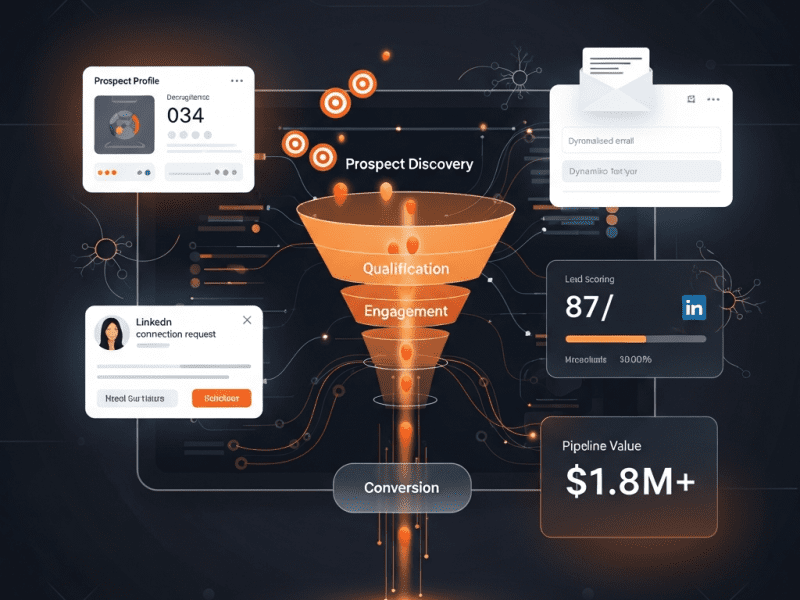
We built an AI-powered lead generation machine for Pinnacle B2B Consulting — identifying, qualifying, and engaging ideal prospects automatically, generating 340+ qualified leads per month and filling their sales pipeline with 47 booked discovery calls weekly.
AI Lead Generation Strategy, Ideal Customer Profiling, AI Prospecting Automation, Lead Scoring & Qualification Engine, Multi-Channel Outreach Automation, Conversational Lead Capture, Pipeline Intelligence Dashboard
Tools & Platforms Used
ChatGPT API (OpenAI), Clay.com, Apollo.io, Instantly.ai, Phantombuster, LinkedIn Sales Navigator, Zapier, Make (Integromat), HubSpot CRM, Calendly, Typeform, WordPress, Google Sheets, Slack, Airtable, Clearbit, Hunter.io
Project Year
2025
The Overview
Pinnacle B2B Consulting is a specialized management consulting firm offering digital transformation, operational efficiency, and growth strategy services to mid-market companies (50-500 employees) across manufacturing, logistics, and healthcare verticals. With an average deal size of $35,000-$80,000 and a 4-6 month sales cycle, every qualified lead in their pipeline represents significant revenue potential.
Despite their expertise and strong client results, Pinnacle had a painful lead generation problem. Their business development relied almost entirely on three fragile sources: personal referrals from the founding partners, sporadic inbound inquiries from their website (averaging just 8-12 per month), and occasional conference networking. There was no systematic, predictable, scalable lead generation engine.
The founders were spending 15-20 hours per week on manual prospecting — scrolling through LinkedIn, crafting individual outreach messages, researching companies one by one, and following up with prospects who never responded. Despite this enormous time investment, they were generating barely enough pipeline to sustain the business, let alone grow it.
They needed to stop hunting for leads manually and start engineering a system that discovers, qualifies, engages, and nurtures ideal prospects automatically — running 24/7 whether the founders are in client meetings, on vacation, or asleep.
We designed and deployed a comprehensive AI-powered lead generation ecosystem that transformed Pinnacle’s business development from a manual, founder-dependent activity into an automated, intelligent, always-on pipeline generation machine.
The Challenge
Pinnacle was facing a cascading set of business development challenges:
Founder-Dependent Pipeline: 90% of new business came from the two founding partners’ personal networks and manual outreach. If they stopped prospecting for a week, the pipeline dried up within 30 days. The business had zero lead generation that functioned independently of the founders’ daily effort.
No Ideal Customer Definition: Despite 6 years in business, Pinnacle had never formally defined their Ideal Customer Profile (ICP). They pursued any company that showed interest, wasting time on prospects that were too small, wrong industry, wrong stage, or wrong geography — resulting in a 6% close rate on proposals.
Manual Research Drain: For every prospect the founders wanted to reach out to, they spent 20-35 minutes manually researching the company (revenue, employee count, recent news, tech stack, decision-makers, pain points). At this rate, they could research and contact a maximum of 12-15 new prospects per week.
Generic Outreach: Cold emails and LinkedIn messages were written one-at-a-time with minimal personalization beyond “Hi [First Name], I noticed your company…” resulting in a dismal 2.1% response rate and 0.3% meeting booking rate.
No Lead Scoring: Every lead was treated equally. A VP of Operations at a 200-employee manufacturing company actively searching for consulting help received the same follow-up cadence as an intern who accidentally downloaded a whitepaper. No prioritization, no segmentation, no intelligence.
Follow-Up Black Hole: 67% of interested prospects received zero follow-up after the initial outreach. The founders simply forgot, got busy with client work, or lost track in their overflowing inboxes. Warm leads went cold because nobody followed up.
No Nurturing Infrastructure: Prospects who weren’t ready to buy immediately were completely abandoned. There was no email nurture sequence, no content drip, no periodic check-in system. Months later, these same prospects would hire a competitor simply because that competitor stayed top-of-mind.
CRM Chaos: HubSpot CRM existed but was a graveyard of outdated contacts, incomplete records, and meaningless pipeline stages. Nobody trusted the data, so nobody used the system.
Website as a Dead End: Pinnacle’s website received 2,400 monthly visitors but had no lead capture mechanisms beyond a generic “Contact Us” form. 99.5% of visitors left without any interaction. No chatbot, no lead magnets, no exit-intent popups, no content gates.
Zero Visibility into Pipeline Health: The founders couldn’t answer basic questions: “How many qualified prospects are in our pipeline?” “What’s our expected revenue next quarter?” “Which lead sources are actually producing clients?” They were flying blind.
Our Approach & Strategy
We built the system in six structured phases, each layering intelligence and automation on top of the previous:
We started by answering the most important question in lead generation: “Who exactly should we be targeting, and why?”
Conducted deep-dive interviews with both founding partners — analyzing their 6 years of client history:
Which clients generated the highest revenue?
Which clients had the shortest sales cycles?
Which clients renewed or expanded?
Which clients referred others?
Which clients were painful and unprofitable?
Analyzed 42 past and current client accounts across 14 data points each:
Company size (employees and revenue)
Industry and sub-vertical
Geography
Decision-maker title and department
Business stage (growth phase, restructuring, scaling)
Technology maturity level
Pain points that triggered engagement
Deal size and profitability
Sales cycle length
Source of initial contact
Lifetime value
Referral generation
Satisfaction scores
Churn indicators
From this analysis, we built 3 distinct Ideal Customer Profiles (ICPs):
ICP
Description
Priority
ICP-1: Growth Manufacturer
Manufacturing companies, 100-400 employees, $15M-$80M revenue, actively investing in digital transformation or operational efficiency. Decision maker: VP Operations or COO. Geography: India (Tier 1 & 2 cities). Pain triggers: rising costs, scaling bottlenecks, outdated processes.
🔴 Primary
ICP-2: Scaling Logistics
Logistics and supply chain companies, 75-300 employees, $10M-$50M revenue, expanding geographically or adding service lines. Decision maker: CEO, Director of Operations, or Head of Strategy. Pain triggers: coordination breakdowns, technology gaps, margin compression.
🟡 Secondary
ICP-3: Healthcare Operator
Healthcare groups (multi-clinic, hospital networks, diagnostic chains), 50-250 employees, $8M-$40M revenue, navigating regulatory changes or rapid expansion. Decision maker: CEO, Administrator, or Director of Strategy. Pain triggers: compliance complexity, patient experience gaps, operational inefficiency.
🟢 Tertiary
Built Negative Persona Filters — criteria for auto-disqualifying leads:
Companies under 40 employees (too small for Pinnacle’s fee structure)
Companies over 600 employees (typically have in-house consulting teams)
Startups under 2 years old (budget constraints, unstable requirements)
Companies in active financial distress (bankruptcy, lawsuits, major layoffs)
Industries outside the three ICP verticals (unless referred directly)
Created a Total Addressable Market (TAM) Map — identified 4,200+ companies in India matching the three ICPs using Apollo.io, LinkedIn Sales Navigator, and Clearbit data enrichment.
Phase 2: AI Prospecting & Data Enrichment Engine (Week 2)
With clear ICPs defined, we built the automated prospecting machine:
Apollo.io + Clay.com Integration:
Configured Apollo.io with ICP filters to automatically surface matching companies and decision-makers daily
Connected to Clay.com for multi-source data enrichment — pulling company data from LinkedIn, Crunchbase, Google News, G2, Glassdoor, and company websites simultaneously
For each prospect, AI automatically compiled a Prospect Intelligence Brief:
Configured to automatically visit profiles of target decision-makers
Extract mutual connections, recent posts, group memberships, and engagement patterns
Feed data into Clay.com for enrichment pipeline
Hunter.io + Clearbit Email Verification:
Every email address triple-verified before entering outreach pipeline
Bounce rate maintained under 1.5% to protect domain reputation
Daily Automated Output: The system surfaces 25-35 new verified, enriched, ICP-matched prospects per business day — each with a complete intelligence brief ready for outreach.
Phase 3: AI-Powered Personalized Outreach System (Week 3)
Generic mass emails die in spam folders. We built a system that creates genuinely personalized, one-to-one quality outreach at scale:
ChatGPT-Powered Email Generation:
Each Prospect Intelligence Brief feeds into a custom ChatGPT prompt chain that generates hyper-personalized email sequences:
Email 1 (Day 1): The Relevant Opener — References specific company news, achievement, or pain signal. Positions Pinnacle’s expertise against that specific context. Soft CTA (reply or resource).
Email 2 (Day 3): The Value Add — Shares a relevant case study, insight, or framework related to the prospect’s industry. No hard sell. Builds credibility.
Email 3 (Day 7): The Direct Ask — Clear, concise meeting request with specific value proposition. Includes Calendly link.
Email 4 (Day 12): The Breakup — Final follow-up with graceful exit and open door. Often generates the most replies.
Example of AI-Generated Personalization (vs. Generic):
Element
❌ Generic (Old Way)
✅ AI-Personalized (New Way)
Subject Line
“Quick question about your operations”
“Saw TechnoForge’s new Pune plant — here’s what top manufacturers do differently at this stage”
Opening Line
“Hi Rajesh, I hope this email finds you well.”
“Hi Rajesh — congratulations on the Pune expansion announcement last month. Scaling from 2 to 3 plants is exactly the inflection point where operational complexity tends to double overnight.”
Value Prop
“We help companies improve their operations.”
“We recently helped a 180-person auto parts manufacturer reduce production bottlenecks by 34% during their third-plant transition — the exact stage TechnoForge is navigating right now.”
CTA
“Let me know if you’d like to chat.”
“Would a 20-minute call next Tuesday or Thursday make sense? I can share the specific framework we used — no pitch, just perspective. [Calendly link]”
Instantly.ai Deployment:
All email sequences deployed through Instantly.ai with:
Warm-up protocol for new sending domains (protecting deliverability)
Smart sending windows (optimized per prospect timezone)
Automatic reply detection and sequence pausing
A/B testing on subject lines, opening lines, and CTAs
Unified inbox for all replies
LinkedIn Outreach Sequence (Parallel Track):
Day 1: Connection request with personalized note (under 300 characters)
Day 2 (after acceptance): Thoughtful comment on their recent LinkedIn post
Day 4: Value-first DM sharing relevant resource
Day 8: Direct meeting request via DM
Multi-Channel Coordination:
Zapier automation ensures LinkedIn and email sequences are synchronized — if a prospect replies on one channel, outreach pauses on all others to prevent awkward duplicate touches.
Phase 4: AI Lead Scoring & Qualification Engine (Week 4)
Not all leads are equal. We built an intelligent system that scores, ranks, and prioritizes every lead:
For the 85% of prospects who aren’t ready to buy immediately, we built an intelligent nurture system that keeps Pinnacle top-of-mind until the timing is right:
AI-Powered Email Nurture Sequences:
Created 3 industry-specific nurture tracks (Manufacturing, Logistics, Healthcare) — each containing 12 emails delivered over 90 days:
Each email dynamically personalized using AI — prospect’s name, company, industry, specific pain points, and previous engagement history woven into every message.
Content-Triggered Scoring Updates:
Every nurture email interaction feeds back into the lead scoring model
If a prospect suddenly opens 3 emails in a row after 60 days of inactivity → “Re-engagement Alert” triggers in Slack with recommended action
HubSpot CRM Pipeline Automation:
Completely rebuilt Pinnacle’s HubSpot CRM with clean pipeline stages:
Automated stage transitions — when a meeting is booked via Calendly, prospect auto-moves to “Discovery Call Booked.” When a proposal is sent from the proposal template, stage auto-updates.
Deal value prediction: AI estimates likely deal size based on company size, industry, and pain complexity — enabling revenue forecasting.
Meeting Preparation AI:
When a discovery call is booked, AI automatically generates a Pre-Call Intelligence Package delivered to the founder’s inbox 1 hour before the meeting:
Full Prospect Intelligence Brief (updated with latest data)
Recommended talking points based on prospect’s engagement history
Relevant case studies to reference during conversation
Dynamic scoring system evaluating ICP match, decision-maker level, engagement signals, intent signals, and timing indicators
AI Qualification Chatbot
Website chatbot that conversationally qualifies visitors, scores them in real-time, and routes hot leads to instant booking
3 Industry-Specific Nurture Tracks
90-day automated email sequences (12 emails each) tailored to Manufacturing, Logistics, and Healthcare prospects
Pre-Call Intelligence Packages
AI-generated meeting prep briefs delivered automatically 1 hour before every discovery call
HubSpot CRM Rebuild
Clean 11-stage pipeline with automated stage transitions, deal value predictions, and complete prospect history
Pipeline Intelligence Dashboard
Real-time dashboard tracking funnel metrics, engagement data, pipeline value, projected revenue, and ROI
Weekly AI Performance Reports
Automated Monday morning reports with actionable insights, hot lead recommendations, and optimization suggestions
Results & Impact (Projected / Showcase Metrics)
Metric
Before
After
Change
New Prospects Identified/Month
50-60 (manual)
680+ (automated)
⬆ 1,033%
Qualified Leads Generated/Month
8-12
340+
⬆ 2,733%
Email Open Rate
14%
34%
⬆ 143%
Email Reply Rate
2.1%
12.4%
⬆ 490%
Discovery Calls Booked/Week
2-3
47
⬆ 1,467%
Founder Hours on Prospecting/Week
15-20 hours
2 hours (review + calls only)
⬇ 88%
Proposal Close Rate
6%
22%
⬆ 267%
Average Sales Cycle Length
4-6 months
2.5 months
⬇ 46%
Pipeline Value (Active)
$120,000
$1,840,000+
⬆ 1,433%
Revenue from AI-Sourced Leads (First Quarter)
$0
$285,000
—
Cost Per Qualified Lead
$180 (estimated manual cost)
$8.40
⬇ 95%
Customer Acquisition Cost (CAC)
$4,200
$920
⬇ 78%
📋 Case Study Summary (Concise Version for Portfolio Card)
Challenge: Pinnacle B2B Consulting’s pipeline was 90% dependent on the founders’ manual prospecting — 15-20 hours weekly of LinkedIn scrolling, one-by-one research, and generic outreach producing barely 8-12 inbound leads per month with a dismal 2.1% response rate and 6% close rate.
Solution: We built a complete AI-powered lead generation ecosystem — data-driven ICP definition, automated multi-source prospect discovery enriching 25-35 new leads daily, ChatGPT-powered hyper-personalized outreach sequences, a 100-point dynamic lead scoring engine, AI qualification chatbot on website, industry-specific 90-day nurture tracks, and a full pipeline intelligence dashboard.
Result: Monthly qualified leads exploded from 12 to 340+. Discovery calls went from 2-3 per week to 47. Pipeline value grew from $120K to $1.84M+. Founder prospecting time dropped 88%. AI-sourced leads generated $285,000 in revenue within the first quarter. Cost per qualified lead fell from $180 to $8.40.
Stop Chasing Leads. Start Engineering a Pipeline That Fills Itself.
We build AI-powered lead generation systems that identify your ideal prospects, craft personalized outreach at scale, score and qualify leads automatically, and deliver a predictable, overflowing pipeline — so you can focus on closing deals and serving clients.
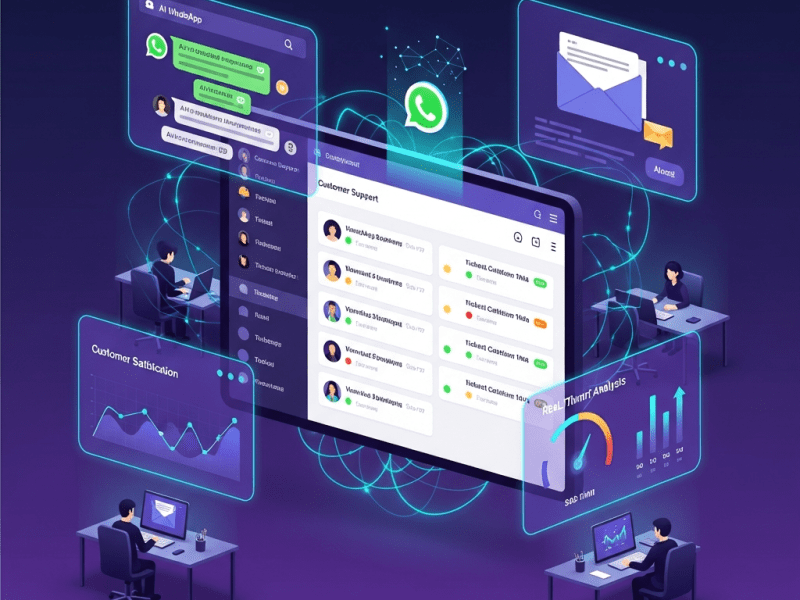
We engineered a complete AI customer support ecosystem for VelocityCart E-Commerce — resolving 82% of tickets automatically, cutting average resolution time from 18 hours to 4 minutes, and transforming frustrated customers into loyal brand advocates.
AI Support Strategy, Intelligent Ticket Routing, AI Knowledge Base Creation, Sentiment Analysis Integration, Multi-Channel Support Automation, Agent Assist AI Dashboard, Escalation Intelligence System
Tools & Platforms Used
ChatGPT API (OpenAI), Freshdesk, Zendesk AI, Intercom Fin, Zapier, Make (Integromat), Notion, Google Sheets, WooCommerce, WhatsApp Business API, Telegram Bot API, Facebook Messenger, Slack, Google Analytics 4
Project Year
2025
The Overview
VelocityCart is a fast-growing multi-category e-commerce platform selling electronics, fashion, home goods, and lifestyle products to over 45,000 active customers across India and Southeast Asia. With 300+ daily orders and a product catalog of 12,000+ SKUs, their customer support infrastructure was crumbling under pressure.
Their 8-person support team worked in shifts to provide coverage from 8 AM to 11 PM IST, but overnight queries went unanswered until the next morning. Ticket backlogs regularly exceeded 400+ unresolved issues. Customer satisfaction scores had dropped to a concerning 2.8 out of 5 stars. Negative reviews citing “terrible support” and “nobody responds” were actively hurting sales conversion rates.
VelocityCart didn’t just need faster support — they needed an entirely new support paradigm. One where AI handles the predictable, repetitive, and time-sensitive queries instantly while empowering human agents to focus on complex, high-value customer interactions that build loyalty and drive retention.
We designed, built, and deployed a comprehensive AI-powered customer support system that fundamentally changed how VelocityCart serves its customers — across their website, email, WhatsApp, Telegram, and Facebook Messenger.
The Challenge
VelocityCart’s support operation was bleeding from multiple wounds:
Massive Ticket Backlog: Average daily incoming tickets exceeded 380, but the team could only resolve 220-250 per day — creating a compounding backlog that grew every single week.
Agonizing Resolution Times: Average first response time was 6 hours during business hours and 14+ hours for overnight queries. Full resolution averaged 18 hours — unacceptable for e-commerce where customers expect instant answers.
Repetitive Query Overload: Deep analysis revealed that 74% of all tickets fell into just 8 predictable categories — order status, delivery tracking, return/refund requests, product availability, payment issues, coupon/discount inquiries, size/specification questions, and account access problems. All automatable.
No Intelligent Routing: Every ticket landed in a single shared inbox. Agents picked randomly. A billing specialist might spend 30 minutes on a technical product question they weren’t equipped to handle, while a simple tracking inquiry sat unattended.
Zero Sentiment Awareness: The system couldn’t distinguish between a mildly curious customer and a furious one about to leave a 1-star review. Both waited in the same queue with identical priority.
No After-Hours Coverage: 11 PM to 8 AM IST — 9 full hours — had zero support coverage. International customers in US, UK, and Australian time zones were completely abandoned during their peak shopping hours.
Fragmented Channel Chaos: Support requests arrived via website chat widget, email, WhatsApp, Facebook Messenger, Instagram DMs, and Telegram — each managed in separate tools with no unified view. Agents frequently missed messages or responded to the same customer twice with conflicting information.
Agent Burnout & Turnover: The support team’s monthly turnover rate was 18%. Agents were overwhelmed, undertrained, and spending most of their time copy-pasting templated responses instead of actually helping customers.
No Proactive Support: The system was entirely reactive — waiting for customers to complain. No proactive notifications about delayed shipments, back-in-stock alerts, or order milestone updates.
Lost Revenue from Support Failures: Exit surveys showed 23% of customers who didn’t complete a purchase cited “couldn’t get my questions answered” as the primary reason. Support failures were directly costing revenue.
Our Approach & Strategy
We implemented a six-phase transformation framework designed to create an intelligent, self-improving support ecosystem:
Phase 1: Support Data Deep Dive & Ticket Taxonomy (Week 1)
Exported and analyzed 12 months of support data — 87,000+ tickets across all channels.
Built a comprehensive Ticket Taxonomy classifying every query type:
Tier
Category
% of Total Volume
Complexity
AI Solvable?
Tier 1
Order Status & Tracking
22%
Low
✅ Fully
Tier 1
Shipping & Delivery Info
14%
Low
✅ Fully
Tier 1
Return & Refund Policy
11%
Low-Medium
✅ Fully
Tier 1
Coupon & Discount Inquiries
8%
Low
✅ Fully
Tier 1
Account Access & Password
6%
Low
✅ Fully
Tier 2
Product Specs & Availability
13%
Medium
✅ With catalog data
Tier 2
Payment & Billing Issues
9%
Medium
⚠️ Partially
Tier 2
Return Processing & Refund Execution
7%
Medium-High
⚠️ Partially
Tier 3
Damaged/Wrong Product Claims
5%
High
❌ Human needed
Tier 3
Complex Complaints & Escalations
3%
Very High
❌ Human needed
Tier 3
Custom Requests & Exceptions
2%
Very High
❌ Human needed
Identified that Tier 1 queries (61% of volume) could be 100% automated — no human needed.
Tier 2 queries (29%) could be partially automated — AI handles initial triage, gathers information, attempts resolution, escalates to human only if needed.
Tier 3 queries (10%) require human expertise — but AI can still assist by pre-gathering information, suggesting resolutions, and drafting response templates.
Mapped average handle time per category — revealing that agents spent 12 minutes on Tier 1 queries that AI could resolve in 15 seconds.
Analyzed peak volume patterns — identified that Monday mornings (post-weekend orders), festival sale periods, and the 6-9 PM IST window were highest volume periods.
Phase 2: AI Knowledge Base & Training Data Architecture (Week 2)
Built a comprehensive AI Knowledge Base containing:
450+ FAQ entries organized by category and subcategory
Cart page → Addresses common purchase hesitations, applies available coupons
Order tracking page → Instantly pulls real-time tracking data
Help center → Guides to relevant articles, escalates if unresolved
Implemented visual support — customers can upload photos (damaged products, wrong items) and AI performs initial assessment before routing to human agents.
📧 Email — AI-Powered Ticket Processing
Connected to Freshdesk via API with custom AI processing layer.
Escalated as “recurring unresolved” with full history
Customer has been waiting 10+ minutes for human agent
Manager notification + apology message with compensation offer
Negative sentiment + high LTV + recent large order
“Save this customer” alert with pre-approved resolution options
Implemented CSAT Prediction Model — AI predicts customer satisfaction score before the ticket is even resolved, allowing preemptive intervention for likely-dissatisfied customers.
Week 6, Days 1-2: AI handles Tier 1 queries only (61% of volume) with human monitoring every response
Week 6, Days 3-4: AI handles Tier 1 + Tier 2 triage with reduced monitoring
Week 6, Days 5-7: Full deployment across all channels with automated quality sampling
Continuous Learning Engine:
Every human agent correction to an AI response feeds back into the model
Weekly prompt refinement based on accuracy metrics
Monthly knowledge base updates based on new products, policy changes, and emerging query patterns
Quarterly full system review with performance benchmarking
Quality Assurance Dashboard:
Real-time monitoring of AI resolution accuracy
False positive/negative tracking (AI thought it resolved but didn’t / AI escalated unnecessarily)
Customer satisfaction comparison: AI-resolved vs. human-resolved tickets
Conversation quality scoring with random sampling audits
Key Features Delivered
Feature
Description
Omnichannel AI Support
Unified AI support across website, email, WhatsApp, Telegram, and Facebook Messenger with cross-channel conversation continuity
Intelligent Ticket Taxonomy
11-category automated classification system with tier-based routing ensuring every query reaches the right resolver instantly
Real-Time Sentiment Analysis
Every message scored for emotion — declining sentiment triggers automatic priority elevation and human intervention
AI Knowledge Base (450+ FAQs)
Comprehensive, self-updating knowledge base covering products, policies, shipping, payments, and troubleshooting
Smart Escalation Matrix
Rule-based + AI-driven escalation system that catches high-risk situations before they become crises
Agent Assist AI Dashboard
Human agents receive full context packages, suggested responses, one-click actions, and real-time AI co-pilot support
Proactive Support Notifications
Automated order updates, delay alerts, back-in-stock notifications, and satisfaction check-ins — support before they ask
Visual Support (Photo Analysis)
Customers upload photos of damaged/wrong products — AI performs initial assessment and categorization
VIP Customer Detection
High-value customers automatically identified and routed to dedicated support with premium response SLAs
Continuous Learning Engine
Every human correction improves AI accuracy — system gets smarter with every interaction
CSAT Prediction Model
AI predicts customer satisfaction before resolution, enabling preemptive intervention for at-risk interactions
Multilingual Support
AI communicates in English, Hindi, Tamil, and Bahasa — auto-detecting customer language preference
Results & Impact (Projected / Showcase Metrics)
Metric
Before
After
Change
Daily Ticket Volume Capacity
250 (team max)
380+ (unlimited AI)
⬆ 52%
Tickets Resolved by AI (No Human)
0%
82%
—
Average First Response Time
6 hours (business) / 14 hours (off-hours)
Under 30 seconds (24/7)
⬇ 99.8%
Average Full Resolution Time
18 hours
4 minutes (AI) / 2.1 hours (human)
⬇ 96%
Ticket Backlog
400+ unresolved
Zero backlog
⬇ 100%
Customer Satisfaction (CSAT)
2.8/5
4.5/5
⬆ 61%
Support-Related Negative Reviews
35/month
4/month
⬇ 89%
Agent Handle Time (Human Tickets)
12 min avg
5 min avg
⬇ 58%
Agent Turnover Rate
18%/month
4%/month
⬇ 78%
Support Hours Coverage
15 hrs/day (8AM-11PM)
24/7/365
⬆ 60%
Purchase Conversion (Support-Assisted)
12%
31%
⬆ 158%
Revenue Saved from Churn Prevention
—
$14,200/month
—
Support Cost Per Ticket
$4.80
$0.62
⬇ 87%
📋 Case Study Summary
Challenge: VelocityCart’s 8-person support team was drowning — 400+ ticket backlogs, 18-hour resolution times, 2.8/5 CSAT scores, and zero after-hours coverage. 74% of queries were repetitive and automatable, yet every ticket required manual human handling.
Solution: We built a comprehensive AI customer support ecosystem spanning website, email, WhatsApp, Telegram, and Messenger. The system features intelligent ticket classification, real-time sentiment analysis, smart escalation logic, an AI-powered agent assist dashboard, proactive customer notifications, and a continuous learning engine that improves with every interaction.
Result: AI now resolves 82% of tickets automatically in under 30 seconds. CSAT jumped from 2.8 to 4.5 out of 5. Ticket backlog eliminated entirely. Support cost per ticket dropped 87% from $4.80 to $0.62. Agent burnout-related turnover fell from 18% to 4%. The system prevents an estimated $14,200/month in customer churn.
Stop Losing Customers to Slow, Frustrating Support
We build AI-powered customer support systems that resolve 80%+ of tickets instantly, work 24/7 across every channel, and make your human agents dramatically more effective — all while cutting support costs by up to 87%.
We built a complete AI content generation engine for BluePeak Digital Agency — enabling them to produce SEO-optimized blog posts, social captions, email sequences, and ad copy 5× faster without sacrificing brand voice or quality.
BluePeak Digital Agency (Fictional/Showcase Project)
Industry
Digital Marketing Agency / B2B Services
Project Duration
5 Weeks
Services Delivered
AI Content Strategy, AI Writing Workflow Setup, Brand Voice Training, Multi-Format Content Automation, Editorial Quality Assurance System
Tools & Platforms Used
ChatGPT (OpenAI API), Claude AI, Jasper AI, SurferSEO, Grammarly Business, Notion AI, Google Docs, WordPress, Zapier, Airtable, Canva AI, Make (Integromat)
Project Year
2025
The Overview
BluePeak Digital Agency is a mid-sized digital marketing firm managing content for 18 active clients across industries including SaaS, healthcare, real estate, and e-commerce. Their four-person content team was responsible for producing over 120 pieces of content per month — blog posts, social media captions, email newsletters, ad copy, website pages, and product descriptions.
The math simply didn’t work anymore. Writers were burning out, deadlines were slipping, quality was becoming inconsistent, and the agency was turning away new clients because they couldn’t scale content production without hiring more full-time writers — a cost they couldn’t justify.
They didn’t need more writers. They needed a smarter way to write.
We designed and implemented a complete AI-powered content generation ecosystem — a structured system of AI tools, custom prompts, brand voice models, editorial workflows, and automation pipelines that transformed how BluePeak creates, reviews, and publishes content at scale.
The Challenge
BluePeak was facing a perfect storm of content bottlenecks:
Volume vs. Capacity Mismatch: 120+ content pieces needed per month across 18 clients, but only 4 writers available — each handling 30+ pieces monthly with zero breathing room.
Brand Voice Inconsistency: With writers juggling multiple client accounts, tone and voice drifted between pieces. A SaaS client’s blog post would accidentally sound like a wellness brand’s newsletter.
SEO Gaps: Writers focused on readability but lacked time for proper keyword research, content optimization, and search intent alignment — resulting in content that read well but ranked poorly.
Slow Turnaround Times: Average time from content brief to published piece was 8-12 days. Clients expected 3-5 days.
Repetitive Research Drain: Writers spent 40-60% of their time on research, outlining, and structuring — before writing a single publishable word.
No Repurposing System: A 2,000-word blog post was published once and never repurposed into social posts, email snippets, video scripts, or ad copy — massive content ROI left on the table.
Client Onboarding Bottleneck: Every new client required 2-3 weeks of “voice learning” before writers could produce on-brand content confidently.
Quality Control Overhead: The senior editor spent 15+ hours per week reviewing and rewriting drafts to meet quality standards.
Our Approach & Strategy
We designed a five-phase implementation framework:
Phase 1: Content Audit & Voice DNA Extraction (Week 1)
Audited BluePeak’s last 6 months of published content across all 18 client accounts — 400+ pieces total.
Identified content types by volume: Blog Posts (35%), Social Captions (25%), Email Newsletters (15%), Ad Copy (12%), Website Pages (8%), Product Descriptions (5%).
For each client, we extracted what we call “Voice DNA” — a comprehensive brand voice profile including:
Tone attributes (e.g., “authoritative but approachable,” “witty but not sarcastic”)
Vocabulary preferences and restrictions (words to use, words to avoid)
Sentence structure patterns (short and punchy vs. long and flowing)
Primary AI Writing Engine: ChatGPT-4 (via API) for long-form content generation with custom system prompts containing Brand Voice DNA.
Secondary AI Engine: Claude AI for nuanced, detailed content requiring deeper reasoning — whitepapers, case studies, thought leadership pieces.
SEO Optimization Layer: SurferSEO integrated into the workflow — every AI-generated draft auto-analyzed for keyword density, content score, NLP terms, heading structure, and competitor benchmarks.
Quality Assurance: Grammarly Business for grammar, tone consistency, and plagiarism detection on every piece before publishing.
Content Repurposing Engine: Custom Zapier + Make automation that takes a published blog post and automatically generates:
5 social media captions (LinkedIn, Instagram, X, Facebook, Threads)
Built an internal Prompt Library in Notion — searchable database of 200+ tested, optimized prompts categorized by content type, industry, and purpose.
Phase 5: Launch, Monitor & Optimize (Week 5)
Soft-launched the new system with 5 client accounts first — monitored output quality, turnaround times, and team feedback.
Identified and fixed 12 prompt refinements needed (mostly tone calibration and industry jargon accuracy).
Full rollout across all 18 client accounts.
Installed performance tracking dashboard in Airtable showing:
Content production velocity (pieces per writer per day)
Average quality score per piece
Client satisfaction ratings
SEO performance of AI-assisted content vs. old manually-written content
Time savings per content type
Scheduled monthly optimization reviews — updating prompts, adding new content types, refining Voice DNA profiles based on client feedback and performance data.
Key Features Delivered
Feature
Description
18 Brand Voice DNA Profiles
Custom AI voice models for each client ensuring every piece sounds authentically on-brand regardless of which writer or AI produces it
47 Custom Prompt Chains
Structured multi-step prompt sequences for every content type — blog posts, emails, social, ads, product descriptions
5-Stage AI Content Pipeline
End-to-end workflow from brief to published piece with AI handling research, outlining, and first drafts
Auto-Repurposing Engine
One blog post automatically generates 10+ derivative content pieces across formats and platforms via Zapier + Make automation
SEO-First Content Generation
Every piece passes through SurferSEO optimization — targeting specific keywords, content scores, and NLP terms before human review
Prompt Library (200+ Prompts)
Searchable Notion database of battle-tested prompts organized by content type, industry, and client
Quality Scoring System
8-criteria rubric scoring every piece on accuracy, voice consistency, SEO, readability, engagement, originality, formatting, and CTA effectiveness
Content Performance Dashboard
Real-time Airtable dashboard tracking velocity, quality scores, SEO rankings, and client satisfaction
120-Page SOP Document
Comprehensive operational manual ensuring any team member (current or future hire) can run the system independently
Canva AI Visual Integration
Auto-generated blog headers, social graphics, and infographic outlines matching each client’s brand kit
Results & Impact (Projected / Showcase Metrics)
Metric
Before
After
Change
Content Pieces Published/Month
120
310+
⬆ 158%
Average Production Time/Piece
8-12 days
2-3 days
⬇ 72%
Writer Output (pieces/person/month)
30
78
⬆ 160%
Brand Voice Consistency Score
6.2/10
9.1/10
⬆ 47%
Average SEO Content Score (SurferSEO)
52/100
81/100
⬆ 56%
Content Repurposing Rate
1 piece → 1 use
1 piece → 10+ uses
⬆ 900%
Time Spent on Research/Outlining
40-60% of writing time
Under 10%
⬇ 83%
New Client Onboarding Time
2-3 weeks
3 days
⬇ 80%
Editor Review Time/Week
15+ hours
5 hours
⬇ 67%
Monthly Content Revenue Capacity
$24,000
$58,000+
⬆ 142%
📋 Case Study Summary
Challenge: BluePeak Digital Agency’s 4-person content team was overwhelmed — producing 120 pieces monthly across 18 clients with inconsistent quality, poor SEO performance, and 8-12 day turnaround times. They couldn’t scale without expensive hires.
Solution: We built a complete AI content generation ecosystem — 18 custom brand voice models, 47 prompt chains, an automated content pipeline with SEO optimization, auto-repurposing engine, and a 200+ prompt library — transforming their writers from typists into AI-augmented content strategists.
Result: Content output jumped 158% (120 → 310+ pieces/month) with the same team. Turnaround dropped from 12 days to 3. Brand voice consistency improved 47%. Each blog post now auto-generates 10+ derivative pieces. Revenue capacity more than doubled to $58K/month.
Want to 5× Your Content Output Without 5× the Cost?
We build AI-powered content engines that let your team produce more, rank higher, and never miss a deadline — while keeping every piece authentically on-brand.
We designed and deployed an AI-powered chatbot and virtual assistant for GreenLeaf Wellness — automating customer inquiries, booking appointments, and driving product recommendations 24/7 across web, WhatsApp, and Messenger.
ChatGPT API (OpenAI), Tidio, ManyChat, Dialogflow, Zapier, WordPress, WooCommerce, WhatsApp Business API, Facebook Messenger
Project Year
2025
The Overview
GreenLeaf Wellness, a growing health and wellness brand offering organic supplements, personalized nutrition plans, and virtual wellness consultations, was struggling to keep up with a rapidly increasing volume of customer inquiries. Their small support team was overwhelmed — response times averaged 14+ hours, cart abandonment sat at 72%, and consultation bookings required tedious back-and-forth emails.
They needed a smarter, always-on solution. That’s where we stepped in.
We built and deployed a custom AI-powered chatbot and virtual assistant ecosystem that transformed how GreenLeaf Wellness interacts with its customers — across their WordPress/WooCommerce website, WhatsApp Business, and Facebook Messenger.
The Challenge
GreenLeaf Wellness faced a cluster of interconnected problems:
Delayed Response Times: Average first-response time exceeded 14 hours during peak periods, leading to frustrated customers and lost sales.
High Cart Abandonment: 72% of users abandoned their carts, many due to unanswered product questions (dosage, ingredients, compatibility).
Manual Booking Bottleneck: Wellness consultation scheduling required 3-5 email exchanges per booking, consuming hours of staff time daily.
No After-Hours Support: With a team operating 9 AM – 6 PM IST, international customers in different time zones received no real-time support.
Repetitive Queries Draining Resources: Over 65% of incoming queries were repetitive (shipping times, return policy, product ingredients) — easily automatable.
Fragmented Communication Channels: Customers reached out via website chat, WhatsApp, Instagram DMs, and email — with no unified system.
Audited 6 months of customer support transcripts (email, chat logs, social DMs).
Identified and categorized the Top 50 most frequently asked questions.
Mapped the complete customer journey — from first visit to purchase to post-purchase support.
Defined chatbot personas, tone of voice (warm, knowledgeable, wellness-focused), and escalation triggers.
Identified 5 key automation opportunities: FAQ handling, product recommendation, appointment booking, order tracking, and lead capture.
Phase 2: Conversational Flow Design & AI Training (Week 2)
Designed 12 primary conversational flows using decision-tree logic combined with AI natural language understanding:
Welcome & Greeting Flow
Product Discovery & Recommendation Engine
Ingredient & Dosage Inquiry Handler
Appointment/Consultation Booking Flow
Order Status & Tracking Flow
Shipping & Delivery Information
Return & Refund Policy Flow
Subscription & Membership Inquiry
Lead Capture & Newsletter Signup
Abandoned Cart Recovery Flow
Post-Purchase Follow-Up & Review Request
Human Handoff / Escalation Flow
Trained the AI model on GreenLeaf’s product catalog (80+ SKUs), brand guidelines, wellness content library, and FAQ database.
Built a product recommendation engine using conditional logic — asking users about their wellness goals, dietary restrictions, and preferences, then suggesting curated product bundles.
Phase 3: Development & Integration (Week 3)
Website Chatbot: Deployed on WordPress/WooCommerce using Tidio with custom ChatGPT API integration for natural, context-aware conversations.
WhatsApp Virtual Assistant: Built via WhatsApp Business API + ManyChat, enabling customers to browse products, book consultations, and track orders directly within WhatsApp.
Facebook Messenger Bot: Configured for lead generation, product inquiries, and seamless handoff to human agents.
CRM Integration: Connected chatbot data to HubSpot CRM via Zapier — every lead, conversation, and booking auto-synced with contact records.
Calendar Integration: Integrated Google Calendar + Calendly for real-time consultation availability and instant booking confirmations.
WooCommerce Integration: Enabled real-time order status lookup, product search, and cart recovery triggers directly within chat.
Phase 4: Testing, Launch & Optimization (Week 4)
Conducted 200+ test conversations across all channels to validate accuracy, tone, and flow logic.
A/B tested welcome messages, product recommendation sequences, and CTA placements.
Launched across all three channels simultaneously with a soft-launch to 20% of traffic, then full rollout.
Set up analytics dashboards tracking: conversation volume, resolution rate, handoff rate, booking conversion, and revenue attributed to chatbot.
Key Features Delivered
Feature
Description
24/7 Multilingual Support
AI chatbot handles queries in English, Hindi, and Tamil round the clock
Smart Product Recommendations
Interactive quiz-style flow recommending products based on user goals and preferences
Automated Appointment Booking
Customers book wellness consultations in under 60 seconds — no human intervention needed
Abandoned Cart Recovery
Automated WhatsApp & web chat nudges with personalized product reminders and discount codes
Order Tracking in Chat
Customers enter order ID and instantly receive shipping status, tracking links, and delivery ETA
Human Handoff with Context
When AI can’t resolve, it seamlessly transfers to a human agent — with full conversation history
Lead Capture & Segmentation
Captures name, email, phone, wellness goals — auto-segments and pushes to CRM
Post-Purchase Engagement
Automated follow-ups asking for reviews, offering complementary product suggestions
Analytics Dashboard
Real-time dashboard showing conversations, CSAT, resolution rates, and revenue attribution
Results & Impact (Projected / Showcase Metrics)
Metric
Before
After
Change
Average First Response Time
14 hours
Under 15 seconds
⬇ 99.9%
Cart Abandonment Rate
72%
48%
⬇ 33%
Consultation Bookings/Month
35
120+
⬆ 243%
Customer Queries Handled Automatically
0%
78%
—
Customer Satisfaction (CSAT)
3.2/5
4.6/5
⬆ 43%
Support Team Hours Saved/Week
—
32 hours
—
Revenue Attributed to Chatbot (Month 1)
—
$8,400
—
Lead Capture Rate
4%
18%
⬆ 350%
📋 Case Study Summary
Challenge: GreenLeaf Wellness was losing sales and customers due to slow response times, high cart abandonment, and a manual booking process that couldn’t scale.
Solution: We built a custom AI chatbot ecosystem powered by ChatGPT API, deployed across their WooCommerce website, WhatsApp, and Facebook Messenger — automating 78% of customer queries, enabling instant consultation bookings, and recovering abandoned carts with smart, personalized nudges.
Result: Response time dropped from 14 hours to under 15 seconds. Cart abandonment fell by 33%. Consultation bookings tripled. The chatbot generated $8,400 in attributed revenue in its first month alone.
Ready to Let AI Handle Your Customer Conversations?
We build intelligent chatbots and virtual assistants that work 24/7 — answering questions, booking appointments, recovering abandoned carts, and capturing leads while you sleep.