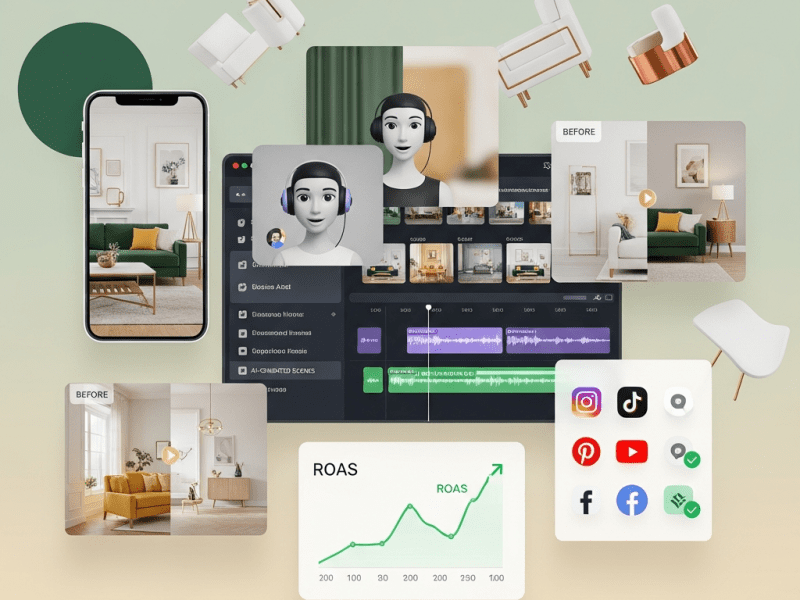
We built a complete AI video and ad creation studio for UrbanNest Home Décor — producing 280+ scroll-stopping video ads and static creatives monthly at 92% lower cost, increasing ROAS from 2.1× to 6.8× across five advertising platforms.
AI Video Production Strategy, AI Ad Creative Generation, Script-to-Video Automation, Dynamic Product Video Ads, UGC-Style AI Video Creation, Multi-Platform Ad Adaptation, Performance Creative Testing System, Brand Asset Library Development
Tools & Platforms Used
ChatGPT API (OpenAI), Runway ML, HeyGen, Synthesia, Eleven Labs, CapCut Pro, Canva AI, Predis.ai, AdCreative.ai, Midjourney, DALL·E 3, Pika Labs, D-ID, Descript, Meta Ads Manager, Google Ads, TikTok Ads Manager, YouTube Ads, Pinterest Ads, Zapier, Make (Integromat), Google Sheets, Airtable, Notion, WordPress, WooCommerce
Project Year
2025
The Overview
UrbanNest Home Décor is a direct-to-consumer e-commerce brand selling premium, design-forward furniture, home accessories, and décor pieces through their WooCommerce store and marketplace presence on Amazon and Flipkart. With a catalog of 450+ products, average order value of $185, and customers across India’s Tier 1 and Tier 2 cities, they’d built a loyal following — but growth had hit a visible ceiling.
The problem wasn’t their products. It wasn’t their pricing. It wasn’t even their marketing budget ($28,000/month across Meta, Google, YouTube, Pinterest, and TikTok). The problem was their creative production bottleneck.
In today’s scroll-first, video-dominant advertising landscape, the brands that win are the brands that produce the most creative variations, test relentlessly, and refresh their ads before fatigue sets in. UrbanNest was producing just 8-12 new ad creatives per month — a mix of static product images shot by their in-house photographer and occasional 30-second videos produced by a freelance videographer at $800-$1,200 per video.
By the time a video ad was conceptualized, scripted, shot, edited, and approved, 3-4 weeks had passed. By then, the trend had moved on, the ad fatigue had set in on their existing creatives, and competitors with faster creative cycles were eating their market share. They were stuck in an impossible loop: they needed more creative volume to scale profitably, but traditional production methods were too slow, too expensive, and too rigid to deliver.
We designed and deployed a complete AI-powered video and ad creation studio — a system that transforms product photos, brand guidelines, and strategic briefs into hundreds of platform-optimized video ads, static creatives, and UGC-style content pieces at a fraction of the traditional cost and timeline.
The Challenge
UrbanNest’s creative production operation was crippled by overlapping bottlenecks:
Catastrophic Creative Volume Deficit: Meta’s algorithm alone recommends testing 5-10 new creative variations per ad set per week for optimal performance. With 6 active campaigns across 4 product categories, UrbanNest needed 120-240 new creatives per month minimum. They were producing 8-12. Their creative pipeline was operating at roughly 5% of required capacity.
Agonizing Production Timelines: The average lifecycle of a single video ad from concept to published:
Day 1-3: Creative brief and concept development
Day 4-7: Script writing and revision (2-3 rounds)
Day 8-12: Videographer scheduling, shooting, and raw footage delivery
Day 13-17: Editing, motion graphics, music, and sound design
Day 18-20: Internal review and revision rounds (average 2.4 rounds)
Day 21-25: Final approval and platform adaptation
Total: 3-4 weeks per video ad — in an industry where trends change weekly
Prohibitive Production Costs: Each professionally produced video ad cost $800-$1,200. At the volume needed (120+ per month), traditional production would cost $96,000-$144,000 monthly — more than 3× their entire marketing budget. Even their static creatives cost $150-$300 each when including photographer and designer time.
Single-Format Limitation: Every ad was produced in one format and one aspect ratio. A 16:9 YouTube ad couldn’t be used on Instagram Stories (9:16) or Facebook Feed (1:1) without expensive re-editing. Platform-specific creative optimization was virtually nonexistent.
No UGC-Style Content: User-generated content style ads consistently outperform polished studio content on Meta and TikTok — often by 40-70% in engagement and conversion rates. But UrbanNest had no UGC creator network, no system for producing authentic-feeling content at scale, and their brand team was uncomfortable with “imperfect” aesthetics.
Creative Fatigue Destroying ROAS: The same 8-12 ads ran for 6-8 weeks before being replaced. By week 3, frequency metrics showed the same users were seeing the same ads 8-12 times. Click-through rates dropped by 65% after week 3. Cost per acquisition (CPA) increased by 120% on fatigued creatives. Their Return on Ad Spend (ROAS) had declined from 3.4× to 2.1× over the past 6 months — primarily due to creative fatigue.
Zero Product Launch Velocity: When UrbanNest launched a new product collection (every 6-8 weeks), it took 2-3 weeks to produce launch ads — meaning the critical launch momentum window was completely missed. Competitors who could produce launch-day creative won the discovery battle.
No Creative Performance Data Loop: The team had no system connecting ad creative performance back to creative production decisions. Nobody could answer: “Which visual style generates highest ROAS?” “Do lifestyle shots outperform product-on-white?” “Does the ‘problem-agitation-solution’ script framework beat ‘benefit-led’ frameworks?”
Platform Mismatch: The same generic 30-second horizontal video was uploaded to YouTube, Instagram Reels, TikTok, Facebook Feed, and Pinterest — ignoring that each platform has dramatically different creative best practices, optimal lengths, and audience expectations.
Seasonal & Trend Paralysis: When a home décor trend went viral on Instagram or TikTok (e.g., “cottagecore,” “japandi minimalism,” “dopamine décor”), UrbanNest couldn’t produce trend-aligned content fast enough to capitalize. By the time their videos were ready, the trend had peaked and declined.
Our Approach & Strategy
We built the AI creative studio in five structured phases:
Phase 1: Creative Audit, Brand System & AI Asset Preparation (Week 1)
Before generating a single AI creative, we needed to build the foundation:
Creative Performance Audit:
Analyzed 18 months of ad performance data across all platforms (142 total creatives):
Ranked every creative by ROAS, CTR, CPA, thumb-stop rate (3-second video view rate), and hold rate (% watched to completion)
Identified the Top 15 highest-performing creatives and reverse-engineered what made them work:
Pattern Identified
Performance Impact
Frequency in Top 15
Product shown in real room setting (lifestyle)
+43% CTR vs. product on white background
13 of 15
Human hand interacting with product in first 2 seconds
+67% thumb-stop rate
11 of 15
Text overlay with benefit statement in first 1.5 seconds
+38% hold rate
12 of 15
Before/after room transformation
+52% conversion rate
8 of 15
Warm, natural lighting (vs. studio lighting)
+28% engagement rate
14 of 15
UGC-style handheld camera feel
+71% CTR on Meta, +89% on TikTok
6 of 15 (all top performers on Meta/TikTok)
Music with trending audio
+44% completion rate on Reels/TikTok
7 of 15
Price/offer revealed at end (not beginning)
+33% watch-through rate
10 of 15
Identified the Bottom 15 worst-performing creatives and cataloged failure patterns:
Overly polished, commercial-style videos (felt like TV ads — users scrolled past)
Product features listed without emotional context
No human element (just product floating in space)
Slow intros (no hook in first 1.5 seconds)
No text overlays (users watch with sound off — 85% of Meta, 65% of TikTok)
Generic stock music
Single aspect ratio used across all platforms
Brand Creative System (AI-Ready):
Built a comprehensive Brand Creative Toolkit specifically designed for AI generation:
Photography Style: Lifestyle-first, real rooms over studio, warm tones, morning/golden hour lighting, human elements (hands, silhouettes, daily-life moments)
Tone of Voice for Ad Copy: Warm, aspirational but accessible, “design for real life” positioning, conversational not corporate, subtle wit
Music & Audio Direction: Acoustic, warm, lo-fi beats, trending sounds for short-form, brand audio signature for YouTube
15 “Do” Examples + 15 “Don’t” Examples — visual reference library for AI training
Product Asset Library Preparation:
Organized all 450+ product SKUs with:
High-resolution product photos (minimum 3 angles per product)
Output: 3 script variations × 3 aspect ratios = 9 video ad variations per product in approximately 45 minutes
Track 2: UGC-Style AI Talking Head Videos
Input: Product + key selling points + target audience persona
Process:
ChatGPT generates authentic-sounding UGC scripts (“I just bought this shelf from UrbanNest and honestly? I’m obsessed…”)
HeyGen creates realistic AI-generated presenter videos using diverse avatar models
Product B-roll footage (AI-generated or from product library) intercut with talking head
Captions auto-generated and styled in trending format (bold yellow/white text, word-by-word animation)
Trending audio/music overlaid
Exported in 9:16 for Reels, TikTok, and Stories
Output: 4 presenter variations × 3 script angles = 12 UGC-style videos per product in approximately 60 minutes
Key Innovation: These look and feel like genuine user-generated reviews — but are produced entirely by AI, maintaining brand messaging accuracy while capturing the authentic, relatable energy that drives engagement
Track 3: Before/After Transformation Videos
Input: Room “before” scene (bare/bland) + Room “after” scene (styled with UrbanNest products)
Each voiceover generated in under 60 seconds per script — versus 2-3 day turnaround and $150-$300 cost per session with human voice talent
Phase 4: Multi-Platform Ad Deployment & Testing System (Week 4)
Creating ads is only valuable if they’re deployed strategically and tested systematically:
Platform-Specific Creative Optimization Matrix:
Platform
Optimal Length
Aspect Ratio
Hook Window
Audio
Text Overlay
CTA Style
Instagram Reels
15-30 sec
9:16
0.8 sec
Trending audio essential
Bold, centered, word-by-word animation
“Shop Now” button overlay
TikTok
15-45 sec
9:16
0.5 sec
Native/trending sounds
Casual, subtitle-style, yellow/white
“Link in bio” or TikTok Shop
Facebook Feed
15-60 sec
1:1 or 4:5
1.5 sec
Optional (85% watch muted)
Headline at top, benefit bullets
“Shop Now” or “Learn More”
YouTube Shorts
15-60 sec
9:16
1.0 sec
Music + voiceover
Minimal, clean
End card with CTA
YouTube In-Stream
15-30 sec (skippable)
16:9
5 sec (before skip button)
Full audio + voiceover
Minimal text, brand watermark
Companion banner + end CTA
Google Display
6-15 sec (bumper)
16:9 + 1:1
Instant
None (autoplay muted)
Product + price + offer
Click overlay
Pinterest Video Pins
15-30 sec
2:3 or 9:16
1.0 sec
Soft music
Elegant, minimal, serif font
“Get the look” or “Shop”
Every AI-generated video automatically exported in all required formats for each platform — a single creative concept becomes 7 platform-optimized versions without manual re-editing
Structured Creative Testing Protocol:
Implemented a systematic testing methodology replacing random ad uploads:
AI CREATIVE TESTING PROTOCOL ━━━━━━━━━━━━━━━━━━━━━━━━━━━━━━━━━━━━━━━━━━━
LEVEL 1: CONCEPT TEST (Week 1) → Test 5 different creative concepts per product → Budget: $20/concept ($100 total) → Duration: 3 days → Metric: Thumb-stop rate (3-sec view) + CTR → Winner: Top 2 concepts advance
LEVEL 2: VARIATION TEST (Week 2) → For each winning concept, test 4 variations: • Different hooks (first 2 seconds) • Different scripts (same visual, different copy) • Different CTAs • Different music/audio → Budget: $15/variation ($120 total) → Duration: 4 days → Metric: CTR + CPA → Winner: Top variation per concept advances
🎬 PRODUCTION METRICS Total Creatives Produced (This Month): [Live] Videos Produced: [Live] Static Ads Produced: [Live] Average Production Time/Creative: [Live] Production Cost/Creative: [Live] Creatives in Testing Queue: [Live]
📊 PERFORMANCE METRICS (Cross-Platform) Overall ROAS: [Live] Best Performing Creative: [Thumbnail + ROAS] Best Performing Framework: [Name + Avg ROAS] Best Performing Platform: [Name + ROAS] Best Performing Audience: [Name + ROAS] Creatives in "Fatigue Zone": [Count + Alert]
📈 CREATIVE INSIGHTS (AI-Generated Weekly) • "Before/After transformation videos outperforming product showcases by 2.3× ROAS this week" • "UGC-style content with 'Ananya' voice generating 41% higher CTR than 'Narrator' voice on Instagram" • "Cottagecore trending content producing 3.1× ROAS — recommend scaling budget 40%" • "Pinterest ROAS up 67% since switching to 2:3 aspect ratio — continue optimizing for this format"
🔄 CREATIVE LIFECYCLE Active Creatives: [Count] Average Creative Lifespan: [Days] Creatives Retired This Month: [Count] Refresh Pipeline (In Production): [Count] ━━━━━━━━━━━━━━━━━━━━━━━━━━━━━━━━━━━━━━━━
AI Creative Learning Loop:
Every creative’s performance data feeds back into the AI production system:
Which script frameworks generate highest ROAS? → Prioritize those frameworks for new creatives
Which visual styles get highest thumb-stop rates? → Weight AI image generation toward those styles
Which hooks generate longest watch time? → Train ChatGPT to prioritize those hook patterns
Which voiceover profiles perform best by platform? → Auto-assign optimal voice per platform
Which aspect ratios drive most conversions per platform? → Auto-prioritize winning ratios
The system literally gets smarter with every ad it produces — each creative teaches the AI what works better
Monthly Creative Strategy Report (AI-Generated):
Comprehensive analysis delivered first Monday of each month:
Top performing creative themes, formats, and frameworks
Underperforming categories with recommended pivots
Emerging trends to capitalize on
Competitor creative landscape changes
Recommended creative mix for next month
Budget allocation recommendations by platform and format
New product launch creative plan
Scaling Playbook:
Created automated scaling rules:
Trigger
Action
Creative achieves ROAS > 5× for 3+ consecutive days
Auto-increase budget 20% daily (capped at 3× original)
Creative achieves ROAS > 8× for 5+ consecutive days
Flag as “Evergreen Winner” — never pause, only refresh visually
Creative drops below ROAS 2× for 2+ consecutive days
Auto-reduce budget 50% + trigger fatigue check
Creative drops below ROAS 1× for 3+ consecutive days
Auto-pause + archive + trigger replacement production
New product added to WooCommerce
Auto-generate 15 creative variations within 24 hours
Sale/promotion activated
Auto-generate promotion overlay versions of top 10 performing creatives
Key Features Delivered
Feature
Description
5-Track AI Video Production System
Product showcases, UGC-style talking heads, before/after transformations, dynamic catalog videos, and trend response content — all AI-generated
Multi-Platform Auto-Adaptation
Every creative auto-exported in 7 platform-specific formats (Reels, TikTok, Feed, YouTube, Shorts, Display, Pinterest) — no manual re-editing
12 Script Framework Library
Battle-tested script templates for ChatGPT generating high-converting ad copy in seconds
4 AI Brand Voice Profiles
Custom Eleven Labs voiceover personalities matched to different content types and platforms
Structured Creative Testing Protocol
4-level systematic testing methodology (Concept → Variation → Audience → Scale) replacing random ad uploads
Creative Fatigue Auto-Detection
Real-time monitoring that detects performance decline and triggers AI creative refresh before ROAS drops
Dynamic Catalog Videos
Auto-updating video ads that refresh product data, pricing, and offers directly from WooCommerce — zero manual maintenance
Competitor Creative Intelligence
Weekly AI analysis of competitor ad libraries identifying trends, gaps, and competitive response opportunities
AI Creative Learning Loop
Performance data continuously feeds back into AI production — the system produces better-performing creatives with every iteration
Brand Creative Toolkit
Comprehensive AI-ready brand system including color palette, typography, visual style guide, photography direction, voice profiles, and “Do/Don’t” examples
50 AI Lifestyle Room Scenes
Photorealistic room settings generated via Midjourney for instant product placement — eliminating the need for physical photo shoots
Creative Intelligence Dashboard
Real-time dashboard tracking production volume, performance metrics, creative lifecycle, and AI-generated optimization insights
Results & Impact (Projected / Showcase Metrics)
Metric
Before
After
Change
Creative Output/Month
8-12 pieces
280+ pieces
⬆ 2,233%
Video Ads Produced/Month
2-3 videos
180+ videos
⬆ 5,900%
Average Production Time/Creative
3-4 weeks
45 minutes
⬇ 99.7%
Average Production Cost/Video
$800-$1,200
$12-$18 (AI + tools)
⬇ 98.5%
Monthly Creative Production Cost
$12,000+
$960
⬇ 92%
Overall ROAS (Return on Ad Spend)
2.1×
6.8×
⬆ 224%
Cost Per Acquisition (CPA)
$48
$16.20
⬇ 66%
Average Ad Creative Lifespan
6-8 weeks (with fatigue)
12-16 days (auto-refreshed)
Optimized
Thumb-Stop Rate (3-sec view)
22%
51%
⬆ 132%
Click-Through Rate (CTR)
0.8%
3.2%
⬆ 300%
Monthly Ad-Attributed Revenue
$58,800
$190,400
⬆ 224%
New Product Launch Creative Time
3-4 weeks
24 hours
⬇ 96%
Platform Coverage
2 platforms (Meta + Google)
5 platforms (+ TikTok, YouTube, Pinterest)
⬆ 150%
Trend Response Time
2-3 weeks (usually too late)
Under 4 hours
⬇ 99%
📋 Case Study Summary
Challenge: UrbanNest Home Décor was producing just 8-12 ad creatives per month at $800-$1,200 per video — a fraction of the 120+ needed for profitable scaling. Creative fatigue had eroded ROAS from 3.4× to 2.1×. Production took 3-4 weeks per video. They couldn’t respond to trends, launch products with speed, or test enough variations to find winning ads.
Solution: We built a complete AI video and ad creation studio — a 5-track production system generating product showcases, UGC-style talking heads, before/after transformations, dynamic catalog videos, and trend-response content using Runway ML, HeyGen, Eleven Labs, ChatGPT, Midjourney, and CapCut. Combined with structured testing protocols, creative fatigue auto-detection, multi-platform auto-adaptation, and a performance learning loop that continuously improves output quality.
Result: Creative output exploded from 12 to 280+ pieces monthly at 92% lower cost ($12-$18 per video vs. $800-$1,200). ROAS tripled from 2.1× to 6.8×. CPA dropped 66%. Monthly ad-attributed revenue jumped from $58,800 to $190,400. New product launch creatives now ship in 24 hours instead of 3-4 weeks. Trend response time collapsed from weeks to under 4 hours.
Stop Letting Creative Bottlenecks Strangle Your Ad Performance
We build AI-powered video and ad creation studios that produce hundreds of scroll-stopping, platform-optimized creatives at a fraction of traditional costs — turning your ad budget into a revenue multiplication machine with relentless creative testing and AI-driven optimization.